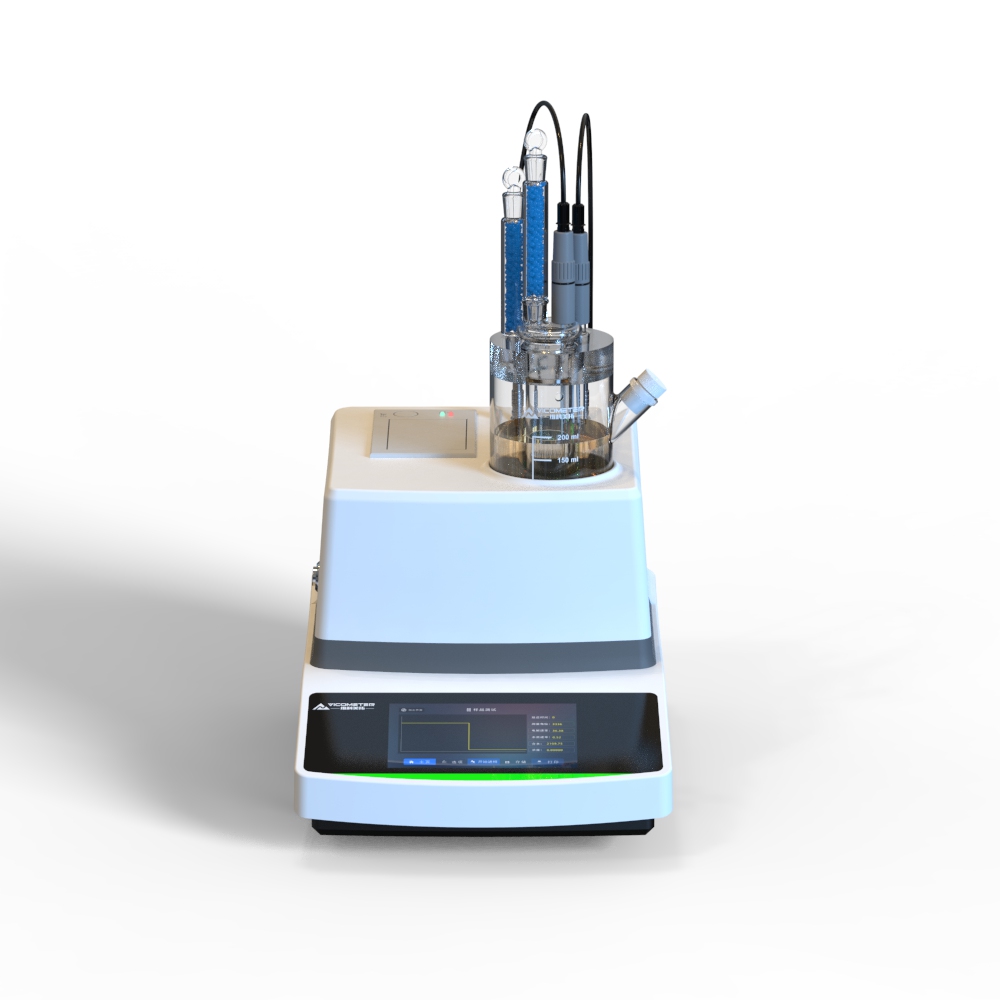
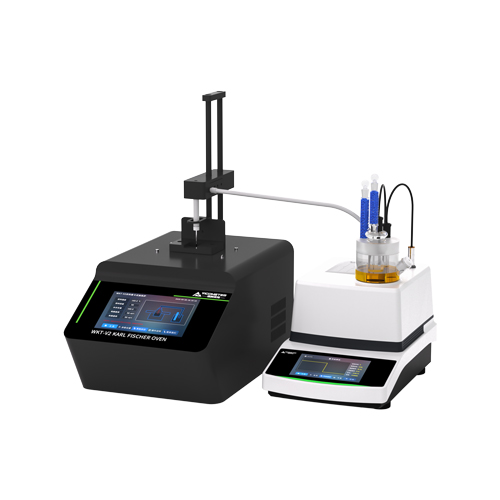
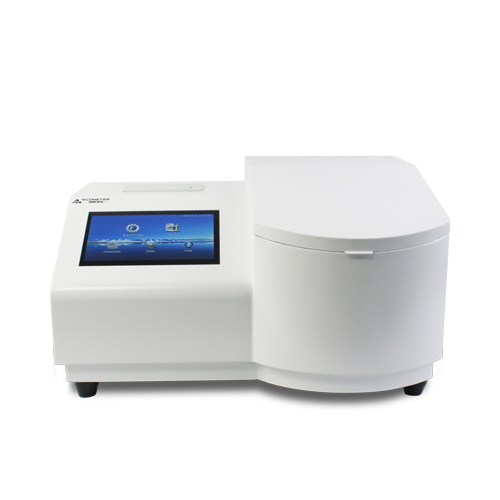
Recently, "A Fully Automatic Karl Fischer Moisture Analyzer," designed by VicoMeter (Jiangsu Victor Instrument Meter Co., Ltd.), was granted a national utility model patent, patent number CN201620728316.7, and received the "Utility Model Patent Certificate" issued by the China National Intellectual Property Administration. This means VicoMeter has been recognized in the field of utility model patents, with deeper protection for its new patents and a further enhancement of its overall competitiveness.
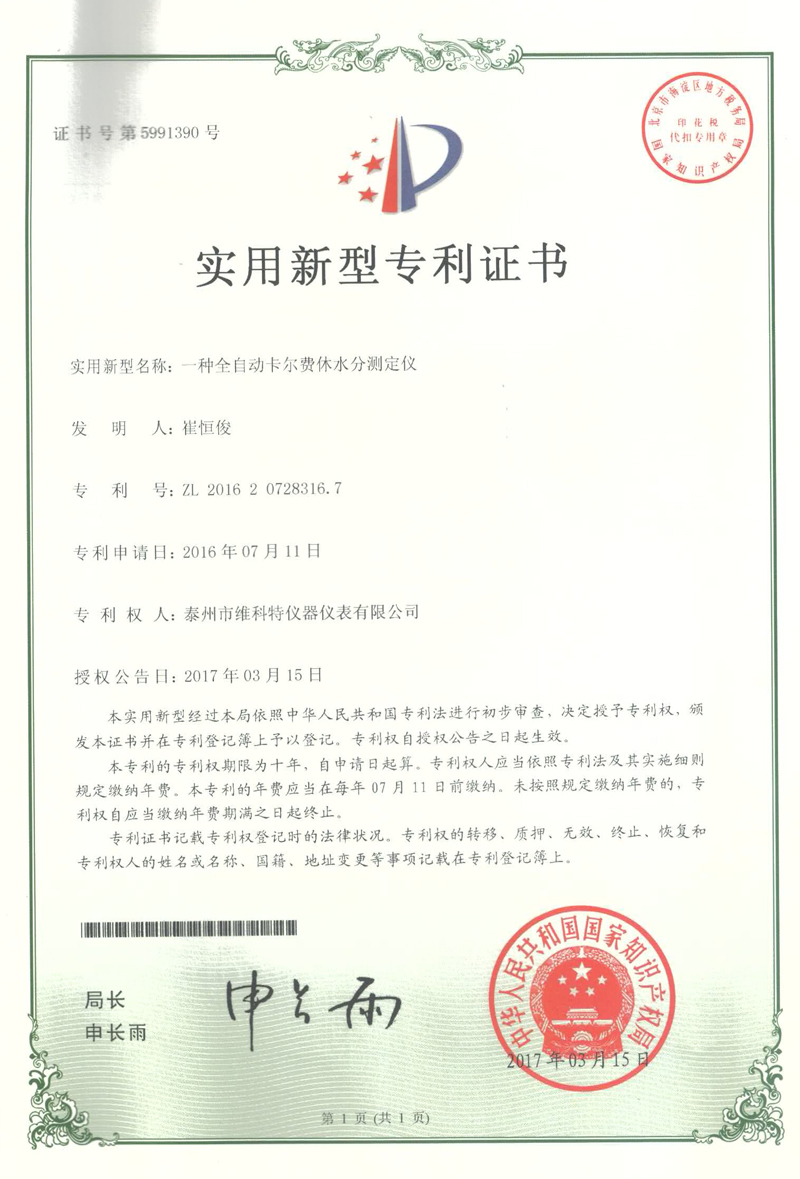
O certificado de patente é um documento legal emitido pelo departamento de administração de patentes do Conselho de Estado (ou seja, a Administração Nacional de Propriedade Intelectual da China) ao requerente da patente, após o pedido de patente ter sido examinado e considerado qualificado, sem que tenham sido encontrados fundamentos de recusa e com o cumprimento das condições para a concessão do direito de patente, juntamente com a decisão de conceder o direito de patente.
Os certificados de patente dividem-se em certificados de patente de invenção, certificados de patente de modelo de utilidade e certificados de patente de desenho industrial.
O modelo de utilidade é um dos três tipos de patente (invenção, modelo de utilidade e desenho industrial). O modelo de utilidade refere-se a uma nova solução técnica proposta para a forma, a estrutura ou a combinação destas em um produto, adequada ao uso prático. A Lei de Patentes estabelece requisitos de atividade inventiva e de nível técnico menores para os modelos de utilidade do que para as patentes de invenção, mas seu valor prático é grande.
Ao longo de anos de constituição, operação e aprimoramento, a VicoMeter aumentou efetivamente a consciência de propriedade intelectual de seus gestores e colaboradores, mobilizou o entusiasmo dos colaboradores para a invenção e a criação, integrou estreitamente os resultados de inovação tecnológica à propriedade intelectual e fortaleceu a competitividade central da empresa.
No futuro, a VicoMeter continuará a oferecer aos clientes produtos e serviços de qualidade e a dar a sua devida contribuição para a indústria de instrumentos analíticos da China — tornando os ensaios mais exatos, a operação mais simples e os usuários mais tranquilos.
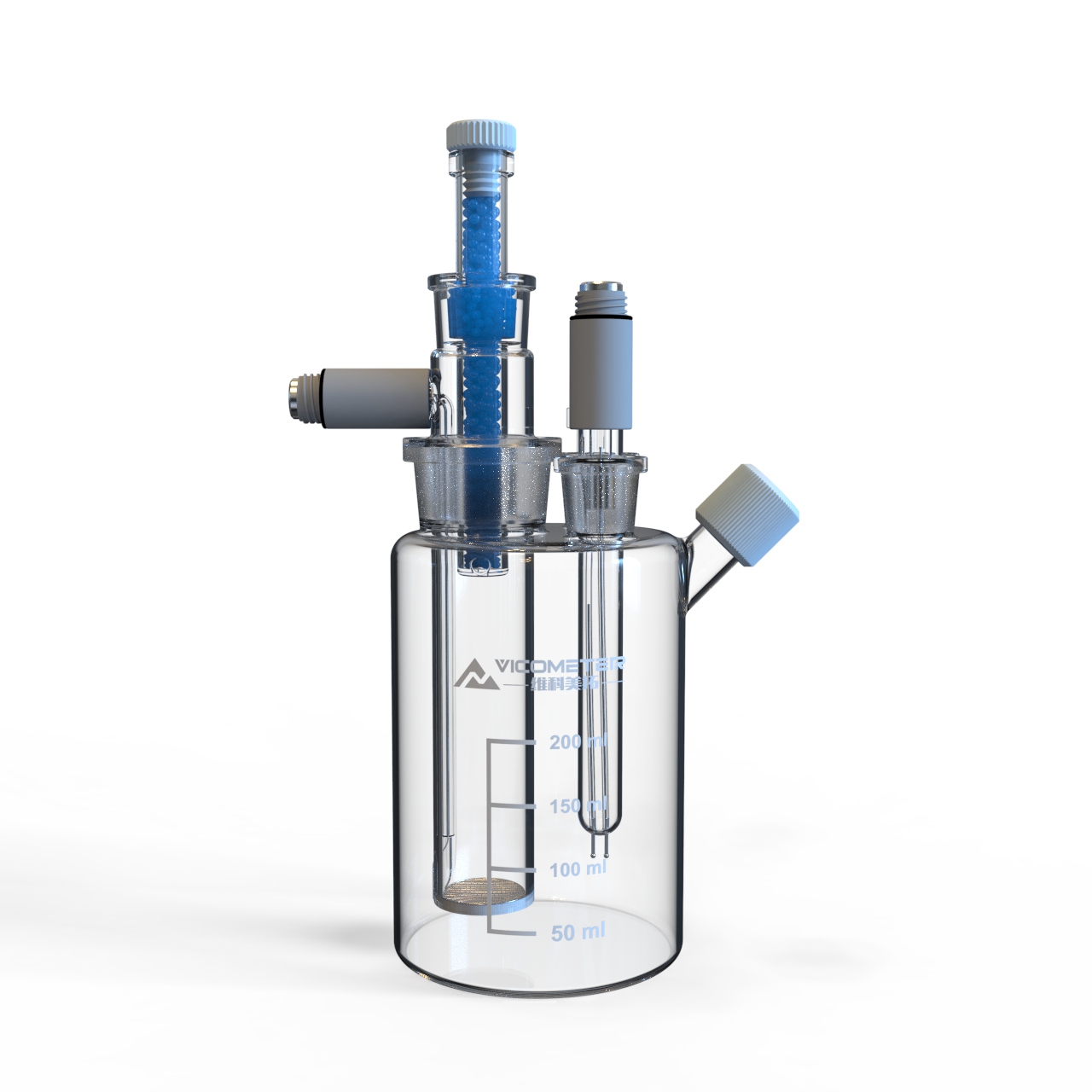
O modelo de utilidade revela um analisador de umidade Karl Fischer totalmente automático. O analisador compreende uma unidade principal, uma célula eletrolítica e um chip de controle disposto no interior da unidade principal. A superfície da unidade principal é dotada de um recesso de acomodação para colocar a célula eletrolítica. O analisador compreende ainda um eletrodo de eletrólise, um eletrodo de medição, um primeiro tubo de secagem e um segundo tubo de secagem. O topo da célula eletrolítica é dotado de um primeiro orifício de inserção para inserir o eletrodo de eletrólise, de um segundo orifício de inserção para inserir o eletrodo de medição, de um terceiro orifício de inserção para inserir e fixar a extremidade inferior do primeiro tubo de secagem e de um quarto orifício de inserção para inserir e fixar a extremidade inferior do segundo tubo de secagem. A lateral da célula eletrolítica é dotada de um orifício de injeção de líquido no qual está disposto um tampão de vedação. A superfície da unidade principal é ainda dotada de uma primeira interface condutiva e de uma segunda interface condutiva, cada uma eletricamente ligada ao chip de controle. A primeira interface condutiva está eletricamente ligada ao eletrodo de eletrólise por meio de um primeiro fio, e a segunda interface condutiva está eletricamente ligada ao eletrodo de medição por meio de um segundo fio. A superfície da unidade principal é dotada de uma tela de exibição.
1. Analisador de umidade Karl Fischer totalmente automático, caracterizado por compreender uma unidade principal, uma célula eletrolítica e um chip de controle disposto no interior da unidade principal; a superfície da unidade principal é dotada de um recesso de acomodação para colocar a célula eletrolítica; o analisador compreende ainda um eletrodo de eletrólise, um eletrodo de medição, um primeiro tubo de secagem e um segundo tubo de secagem; o topo da célula eletrolítica é dotado de um primeiro orifício de inserção para inserir o eletrodo de eletrólise, de um segundo orifício de inserção para inserir o eletrodo de medição, de um terceiro orifício de inserção para inserir e fixar a extremidade inferior do primeiro tubo de secagem e de um quarto orifício de inserção para inserir e fixar a extremidade inferior do segundo tubo de secagem; a lateral da célula eletrolítica é dotada de um orifício de injeção de líquido no qual está disposto um tampão de vedação; a superfície da unidade principal é ainda dotada de uma primeira interface condutiva e de uma segunda interface condutiva, cada uma eletricamente ligada ao chip de controle; a primeira interface condutiva está eletricamente ligada ao eletrodo de eletrólise por meio de um primeiro fio; a segunda interface condutiva está eletricamente ligada ao eletrodo de medição por meio de um segundo fio; e a superfície da unidade principal é dotada de uma tela de exibição e de uma tela de toque disposta sobre a superfície da tela de exibição.
2. O analisador de umidade Karl Fischer totalmente automático, conforme a reivindicação 1, caracterizado por o tampão de vedação ser um tampão de vedação de borracha.
3. O analisador de umidade Karl Fischer totalmente automático, de acordo com a reivindicação 1, caracterizado pelo fato de que a extremidade superior do eletrodo de eletrólise é revestida por uma primeira junta de vedação que cobre o primeiro orifício de inserção; a extremidade superior do eletrodo de medição é revestida por uma segunda junta de vedação que cobre o segundo orifício de inserção; a extremidade inferior do primeiro tubo de secagem é dotada de uma terceira junta de vedação que cobre o terceiro orifício de inserção; e a extremidade inferior do segundo tubo de secagem é dotada de uma quarta junta de vedação que cobre o quarto orifício de inserção.
Um analisador de umidade Karl Fischer totalmente automático
Campo técnico
[0001] The utility model relates to a moisture analyzer, and more particularly to a fully automatic Karl Fischer moisture analyzer.
Contexto
[0002] Existing moisture analyzers require manual operation by users, are not intelligent enough, and have low testing efficiency, causing certain inconvenience to users' testing.
Conteúdo do modelo de utilidade
[0003] The technical problem to be solved by the utility model is to provide a fully automatic Karl Fischer moisture analyzer in view of the above-mentioned defects of the prior art.
[0004] The technical solution adopted by the utility model to solve the technical problem is: constructing a fully automatic Karl Fischer moisture analyzer, comprising a main unit, an electrolytic cell, and a control chip disposed inside the main unit; the surface of the main unit is provided with a receiving slot for placing the electrolytic cell; the analyzer further comprises an electrolysis electrode, a measuring electrode, a first drying tube, and a second drying tube; the top of the electrolytic cell is provided with a first insertion hole for inserting the electrolysis electrode, a second insertion hole for inserting the measuring electrode, a third insertion hole for inserting and fixing the bottom end of the first drying tube, and a fourth insertion hole for inserting and fixing the bottom end of the second drying tube; the side of the electrolytic cell is provided with a liquid injection hole in which a sealing plug is disposed; the surface of the main unit is further provided with a first conductive interface and a second conductive interface, each electrically connected to the control chip; the first conductive interface is electrically connected to the electrolysis electrode via a first wire; the second conductive interface is electrically connected to the measuring electrode via a second wire; and the surface of the main unit is provided with a display screen and a touch screen disposed on the surface of the display screen.
[0005] In the fully automatic Karl Fischer moisture analyzer of the utility model, the sealing plug is a rubber sealing plug.
[0006] In the fully automatic Karl Fischer moisture analyzer of the utility model, the top end of the electrolysis electrode is sleeved with a first sealing gasket covering the first insertion hole; the top end of the measuring electrode is sleeved with a second sealing gasket covering the second insertion hole; the bottom end of the first drying tube is provided with a third sealing gasket covering the third insertion hole; and the bottom end of the second drying tube is provided with a fourth sealing gasket covering the fourth insertion hole.
[0007] Implementing the fully automatic Karl Fischer moisture analyzer of the utility model has the following beneficial effects: when using the analyzer, the electrolysis electrode can be inserted into the electrolytic cell through the first insertion hole, the measuring electrode can be inserted into the electrolytic cell through the second insertion hole, and the first and second drying tubes can be inserted and fixed in the third and fourth insertion holes; the control chip controls the electrolysis electrode and the measuring electrode to work, the display screen shows measurement results, and control commands are input via the touch screen, thereby realizing fully automatic Karl Fischer moisture determination.
Descrição dos desenhos
[0008] O modelo de utilidade será descrito a seguir com mais detalhes, com referência aos desenhos anexos e às formas de realização, nos quais:
[0009] Figure 1 is a structural schematic diagram of the fully automatic Karl Fischer moisture analyzer of the utility model.
Implementação detalhada
[0010] Para tornar mais claros o objetivo, as soluções técnicas e as vantagens do modelo de utilidade, as formas de realização do modelo de utilidade são descritas a seguir em detalhe, com referência aos desenhos anexos.
[0011] As shown in Figure 1, in the first embodiment of the fully automatic Karl Fischer moisture analyzer of the utility model, the analyzer 1 comprises a main unit 2, an electrolytic cell 3, and a control chip disposed inside the main unit 2; the surface of the main unit 2 is provided with a receiving slot 4 for placing the electrolytic cell 3; the analyzer 1 further comprises an electrolysis electrode 5, a measuring electrode 6, a first drying tube 7, and a second drying tube 8; the top of the electrolytic cell 3 is provided with a first insertion hole for inserting the electrolysis electrode 5, a second insertion hole for inserting the measuring electrode 6, a third insertion hole for inserting and fixing the bottom end of the first drying tube 7, and a fourth insertion hole for inserting and fixing the bottom end of the second drying tube 8; the side of the electrolytic cell 3 is provided with a liquid injection hole 9 in which a sealing plug 10 is disposed; the surface of the main unit 2 is further provided with a first conductive interface 11 and a second conductive interface 12, each electrically connected to the control chip; the first conductive interface 11 is electrically connected to the electrolysis electrode 5 via a first wire; the second conductive interface 12 is electrically connected to the measuring electrode 6 via a second wire; and the surface of the main unit 2 is provided with a display screen 13 and a touch screen disposed on the surface of the display screen 13.
[0012] When using the fully automatic Karl Fischer moisture analyzer 1 of the utility model, the electrolysis electrode 5 can be inserted into the electrolytic cell 3 through the first insertion hole, the measuring electrode 6 can be inserted into the electrolytic cell 3 through the second insertion hole, and the first drying tube 7 and second drying tube 8 can be inserted and fixed in the third and fourth insertion holes; the control chip controls the electrolysis electrode 5 and the measuring electrode 6 to work, the display screen 13 shows measurement results, and control commands are input via the touch screen, thereby realizing fully automatic Karl Fischer moisture determination.
[0013] Further, the sealing plug 10 is a rubber sealing plug 10.
[0014] Further, the top end of the electrolysis electrode 5 is sleeved with a first sealing gasket covering the first insertion hole; the top end of the measuring electrode 6 is sleeved with a second sealing gasket covering the second insertion hole; the bottom end of the first drying tube 7 is provided with a third sealing gasket covering the third insertion hole; and the bottom end of the second drying tube 8 is provided with a fourth sealing gasket covering the fourth insertion hole.
[0015] As descrições acima são apenas formas de realização do modelo de utilidade e não se destinam a limitar o escopo de patente do modelo de utilidade. Qualquer estrutura equivalente ou transformação de processo equivalente realizada com base no conteúdo da descrição e dos desenhos do modelo de utilidade, ou a aplicação direta ou indireta em outros campos técnicos relacionados, também se enquadra no escopo de proteção patentária do modelo de utilidade.
Produtos vistos recentemente




Copyright © Jiangsu Victor Instrument Meter Co., Ltd. Todos os direitos reservados | Mapa do site | Suporte técnico: Centro de Operações VicoMeter