
Recently, "A Fully Automatic Karl Fischer Moisture Analyzer," designed by VicoMeter (Jiangsu Victor Instrument Meter Co., Ltd.), was granted a national utility model patent, patent number CN201620728316.7, and received the "Utility Model Patent Certificate" issued by the China National Intellectual Property Administration. This means VicoMeter has been recognized in the field of utility model patents, with deeper protection for its new patents and a further enhancement of its overall competitiveness.
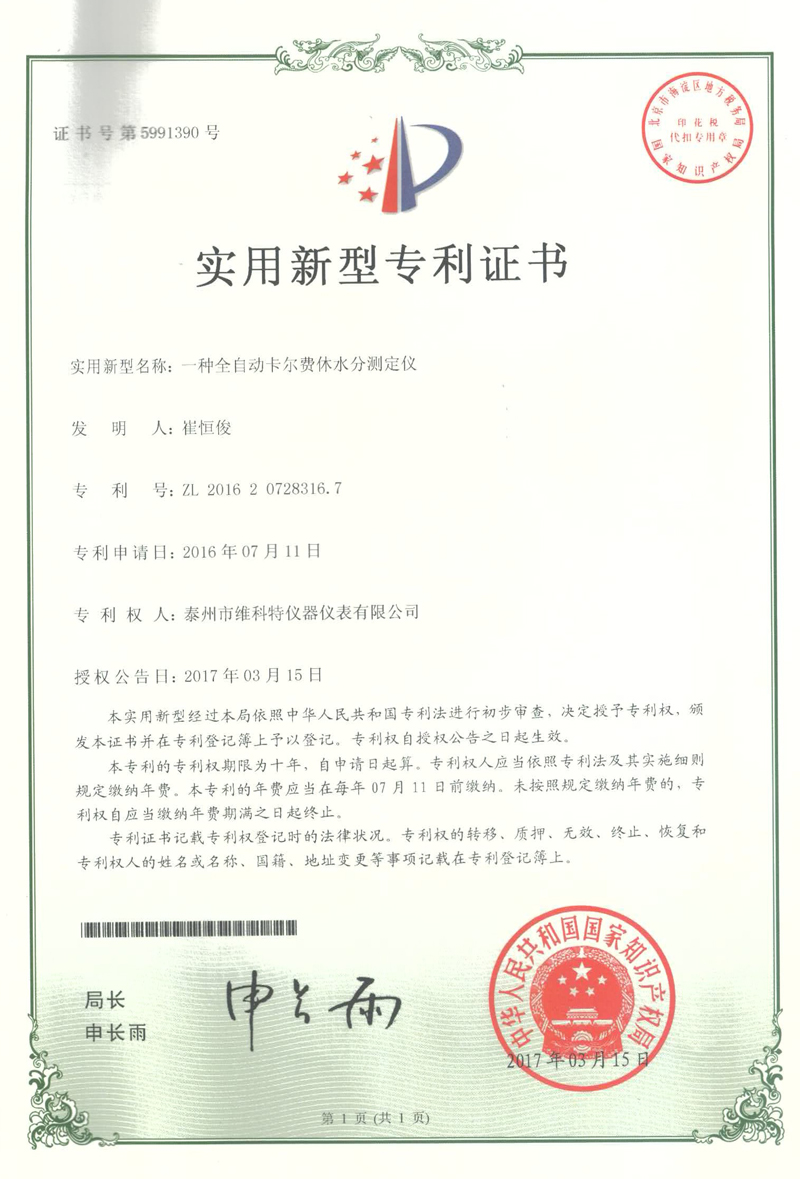
A patent certificate is a legal document issued by the patent administration department under the State Council (i.e., the China National Intellectual Property Administration) to the patent applicant, after a patent application has been examined and found qualified, with no grounds for rejection discovered, and the conditions for granting a patent right have been met, along with the decision to grant the patent right.
Patent certificates are divided into invention patent certificates, utility model patent certificates, and design patent certificates.
A utility model is one of the three types of patents (invention, utility model, and design). A utility model refers to a new technical solution proposed for the shape, structure, or combination thereof of a product that is suitable for practical use. The Patent Law sets lower requirements for the inventiveness and technical level of utility models than for invention patents, but their practical value is great.
Through years of establishment, operation, and improvement, VicoMeter has effectively enhanced the intellectual property awareness of its leaders and employees, mobilized employees' enthusiasm for invention and creation, closely integrated technological innovation achievements with intellectual property, and strengthened the company's core competitiveness.
In the future, VicoMeter will continue to provide customers with quality products and services and make due contributions to China's analytical instrument industry — making testing more accurate, operation simpler, and users more reassured.
The utility model discloses a fully automatic Karl Fischer moisture analyzer. The analyzer comprises a main unit, an electrolytic cell, and a control chip disposed inside the main unit. The surface of the main unit is provided with a receiving slot for placing the electrolytic cell. The analyzer further comprises an electrolysis electrode, a measuring electrode, a first drying tube, and a second drying tube. The top of the electrolytic cell is provided with a first insertion hole for inserting the electrolysis electrode, a second insertion hole for inserting the measuring electrode, a third insertion hole for inserting and fixing the bottom end of the first drying tube, and a fourth insertion hole for inserting and fixing the bottom end of the second drying tube. The side of the electrolytic cell is provided with a liquid injection hole in which a sealing plug is disposed. The surface of the main unit is further provided with a first conductive interface and a second conductive interface, each electrically connected to the control chip. The first conductive interface is electrically connected to the electrolysis electrode via a first wire, and the second conductive interface is electrically connected to the measuring electrode via a second wire. The surface of the main unit is provided with a display screen.
1. A fully automatic Karl Fischer moisture analyzer, characterized in that the analyzer comprises a main unit, an electrolytic cell, and a control chip disposed inside the main unit; the surface of the main unit is provided with a receiving slot for placing the electrolytic cell; the analyzer further comprises an electrolysis electrode, a measuring electrode, a first drying tube, and a second drying tube; the top of the electrolytic cell is provided with a first insertion hole for inserting the electrolysis electrode, a second insertion hole for inserting the measuring electrode, a third insertion hole for inserting and fixing the bottom end of the first drying tube, and a fourth insertion hole for inserting and fixing the bottom end of the second drying tube; the side of the electrolytic cell is provided with a liquid injection hole in which a sealing plug is disposed; the surface of the main unit is further provided with a first conductive interface and a second conductive interface, each electrically connected to the control chip; the first conductive interface is electrically connected to the electrolysis electrode via a first wire; the second conductive interface is electrically connected to the measuring electrode via a second wire; and the surface of the main unit is provided with a display screen and a touch screen disposed on the surface of the display screen.
2. The fully automatic Karl Fischer moisture analyzer according to claim 1, characterized in that the sealing plug is a rubber sealing plug.
3. The fully automatic Karl Fischer moisture analyzer according to claim 1, characterized in that the top end of the electrolysis electrode is sleeved with a first sealing gasket covering the first insertion hole; the top end of the measuring electrode is sleeved with a second sealing gasket covering the second insertion hole; the bottom end of the first drying tube is provided with a third sealing gasket covering the third insertion hole; and the bottom end of the second drying tube is provided with a fourth sealing gasket covering the fourth insertion hole.
A Fully Automatic Karl Fischer Moisture Analyzer
Technical Field
[0001] The utility model relates to a moisture analyzer, and more particularly to a fully automatic Karl Fischer moisture analyzer.
Background
[0002] Existing moisture analyzers require manual operation by users, are not intelligent enough, and have low testing efficiency, causing certain inconvenience to users' testing.
Content of the Utility Model
[0003] The technical problem to be solved by the utility model is to provide a fully automatic Karl Fischer moisture analyzer in view of the above-mentioned defects of the prior art.
[0004] The technical solution adopted by the utility model to solve the technical problem is: constructing a fully automatic Karl Fischer moisture analyzer, comprising a main unit, an electrolytic cell, and a control chip disposed inside the main unit; the surface of the main unit is provided with a receiving slot for placing the electrolytic cell; the analyzer further comprises an electrolysis electrode, a measuring electrode, a first drying tube, and a second drying tube; the top of the electrolytic cell is provided with a first insertion hole for inserting the electrolysis electrode, a second insertion hole for inserting the measuring electrode, a third insertion hole for inserting and fixing the bottom end of the first drying tube, and a fourth insertion hole for inserting and fixing the bottom end of the second drying tube; the side of the electrolytic cell is provided with a liquid injection hole in which a sealing plug is disposed; the surface of the main unit is further provided with a first conductive interface and a second conductive interface, each electrically connected to the control chip; the first conductive interface is electrically connected to the electrolysis electrode via a first wire; the second conductive interface is electrically connected to the measuring electrode via a second wire; and the surface of the main unit is provided with a display screen and a touch screen disposed on the surface of the display screen.
[0005] In the fully automatic Karl Fischer moisture analyzer of the utility model, the sealing plug is a rubber sealing plug.
[0006] In the fully automatic Karl Fischer moisture analyzer of the utility model, the top end of the electrolysis electrode is sleeved with a first sealing gasket covering the first insertion hole; the top end of the measuring electrode is sleeved with a second sealing gasket covering the second insertion hole; the bottom end of the first drying tube is provided with a third sealing gasket covering the third insertion hole; and the bottom end of the second drying tube is provided with a fourth sealing gasket covering the fourth insertion hole.
[0007] Implementing the fully automatic Karl Fischer moisture analyzer of the utility model has the following beneficial effects: when using the analyzer, the electrolysis electrode can be inserted into the electrolytic cell through the first insertion hole, the measuring electrode can be inserted into the electrolytic cell through the second insertion hole, and the first and second drying tubes can be inserted and fixed in the third and fourth insertion holes; the control chip controls the electrolysis electrode and the measuring electrode to work, the display screen shows measurement results, and control commands are input via the touch screen, thereby realizing fully automatic Karl Fischer moisture determination.
Description of Drawings
[0008] The utility model will be further described below with reference to the accompanying drawings and embodiments, in which:
[0009] Figure 1 is a structural schematic diagram of the fully automatic Karl Fischer moisture analyzer of the utility model.
Detailed Implementation
[0010] To make the purpose, technical solutions, and advantages of the utility model clearer, the embodiments of the utility model are further described in detail below with reference to the accompanying drawings.
[0011] As shown in Figure 1, in the first embodiment of the fully automatic Karl Fischer moisture analyzer of the utility model, the analyzer 1 comprises a main unit 2, an electrolytic cell 3, and a control chip disposed inside the main unit 2; the surface of the main unit 2 is provided with a receiving slot 4 for placing the electrolytic cell 3; the analyzer 1 further comprises an electrolysis electrode 5, a measuring electrode 6, a first drying tube 7, and a second drying tube 8; the top of the electrolytic cell 3 is provided with a first insertion hole for inserting the electrolysis electrode 5, a second insertion hole for inserting the measuring electrode 6, a third insertion hole for inserting and fixing the bottom end of the first drying tube 7, and a fourth insertion hole for inserting and fixing the bottom end of the second drying tube 8; the side of the electrolytic cell 3 is provided with a liquid injection hole 9 in which a sealing plug 10 is disposed; the surface of the main unit 2 is further provided with a first conductive interface 11 and a second conductive interface 12, each electrically connected to the control chip; the first conductive interface 11 is electrically connected to the electrolysis electrode 5 via a first wire; the second conductive interface 12 is electrically connected to the measuring electrode 6 via a second wire; and the surface of the main unit 2 is provided with a display screen 13 and a touch screen disposed on the surface of the display screen 13.
[0012] When using the fully automatic Karl Fischer moisture analyzer 1 of the utility model, the electrolysis electrode 5 can be inserted into the electrolytic cell 3 through the first insertion hole, the measuring electrode 6 can be inserted into the electrolytic cell 3 through the second insertion hole, and the first drying tube 7 and second drying tube 8 can be inserted and fixed in the third and fourth insertion holes; the control chip controls the electrolysis electrode 5 and the measuring electrode 6 to work, the display screen 13 shows measurement results, and control commands are input via the touch screen, thereby realizing fully automatic Karl Fischer moisture determination.
[0013] Further, the sealing plug 10 is a rubber sealing plug 10.
[0014] Further, the top end of the electrolysis electrode 5 is sleeved with a first sealing gasket covering the first insertion hole; the top end of the measuring electrode 6 is sleeved with a second sealing gasket covering the second insertion hole; the bottom end of the first drying tube 7 is provided with a third sealing gasket covering the third insertion hole; and the bottom end of the second drying tube 8 is provided with a fourth sealing gasket covering the fourth insertion hole.
[0015] The above descriptions are merely embodiments of the utility model and are not intended to limit the patent scope of the utility model. Any equivalent structure or equivalent process transformation made using the contents of the specification and drawings of the utility model, or direct or indirect application in other related technical fields, shall likewise fall within the scope of patent protection of the utility model.
Recently Viewed Products




Copyright © Jiangsu Victor Instrument Meter Co., Ltd. All rights reserved | Sitemap | Technical Support: VicoMeter Operations Center





























