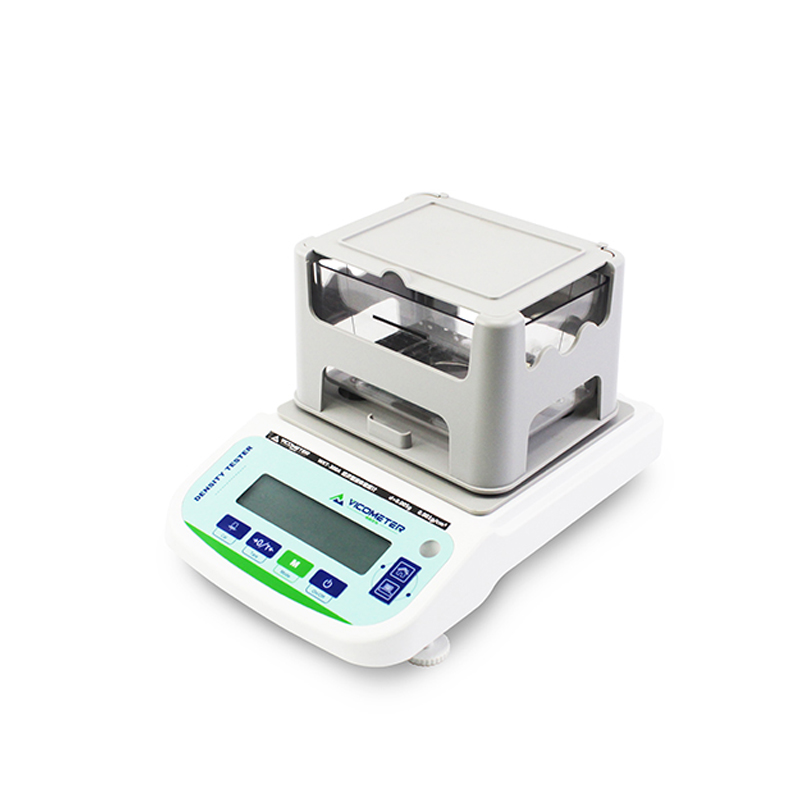
Density Measurement
Density determination of solid, liquid, and viscous samples based on analytical or precision balances—a fast and easy process using density kits and balance applications.

Density determination is an important quality parameter for raw materials and finished products. Several techniques enable accurate density measurement of solid, viscous and liquid materials such as metals, plastics, chemicals, lubricants and food.
A change in density indicates a change in raw materials that may adversely affect the function or quality of the final product. Density measurement of raw materials can confirm material purity: if a substance is adulterated with a cheaper substitute, the measured density of the composite will differ from that of the pure material.
Density can be used to ensure homogeneity. If a manufactured part is not homogeneous, critical properties such as strength and crack resistance may be compromised. For example, a small internal air bubble may eventually cause part failure under stress. Random sampling of parts is a simple, cost-effective way to continuously monitor quality.
Gravimetric density determination methods commonly used in laboratories include the buoyancy method, the displacement method and the pycnometer method.
The most common buoyancy method is based on Archimedes' principle: the weight loss of an object immersed in a fluid equals the weight of the fluid it displaces. This ancient principle, dating back to around 200 BC, is still used today for accurate gravimetric density determination. Accurate density determination therefore depends heavily on accurate weight values.
Buoyancy Method – Archimedes' Principle in Practice
Archimedes' principle states that an object partially or fully immersed in a fluid experiences an upward buoyant force equal to the weight of the fluid it displaces.
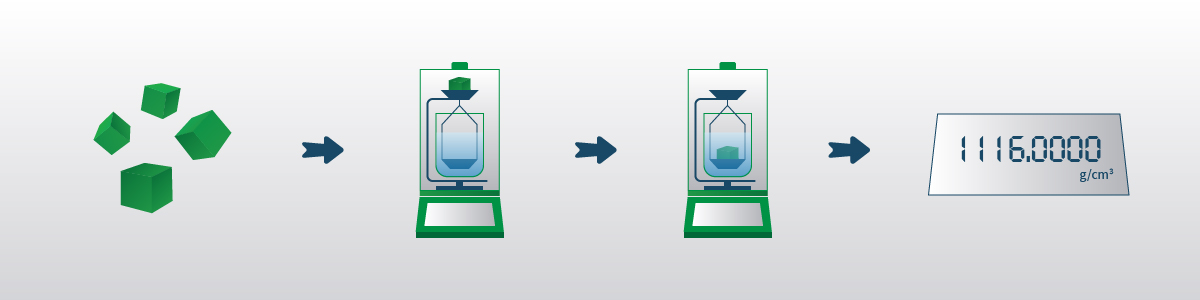
The solid is first weighed in air (A) and then in an auxiliary liquid of known density (B). The density ρ of the solid is calculated as follows:
ρ = Density of the Sample
A = Mass of the Sample in Air
B = Mass of the Sample in the Auxiliary Liquid
ρ0 = Density of the Auxiliary Liquid
ρL = Density of Air
The temperature of the liquid must be taken into account, as each °C can cause a density change on the order of 0.001 to 0.1, an effect visible in the third decimal place of the result.
Method: The beaker of auxiliary liquid sits on the platform or below the balance.
Suitable For: Solids; liquids (with a glass sinker)
Advantages: Fast procedure; flexible sample sizes; weighing instrument already available
Disadvantages: Temperature sensitive; sample must be immersed carefully; no air bubbles may be trapped
Method: The beaker of auxiliary liquid sits on the balance.
Suitable For: Pasty substances (with a gamma sphere); liquids (with a glass sinker); solids
Advantages: Fast procedure; weighing instrument already available
Disadvantages: Temperature sensitive; requires a large sample volume
Method: Glass pycnometer of defined volume.
Suitable For: Liquids, dispersions; powders; fine granules
Advantages: Accurate method; weighing instrument already available
Disadvantages: Temperature sensitive; labor intensive; time consuming; no air bubbles may be trapped
Method: Oscillating U-Tube Technology.
Suitable For: Liquids; gases
Advantages: Fast procedure; automated density determination; small sample volume
Disadvantages: Viscous samples require viscosity correction (available in modern instruments)
There are many standards and specifications for density determination. The most commonly used include:
ISO 1183-1: Plastics — Methods for Determining the Density of Non-Cellular Plastics
OIML G 14: Density Measurement According to OIML
ASTM D792-00: Standard Test Methods for Density and Specific Gravity
GB/T 1033-1986: Test Method for Density and Relative Density of Plastics
GB/T 3850-2015: Methods for Density Determination of Dense Sintered Metal Materials and Hardmetals
……
Air Bubbles
By far the largest source of error in density determination is the limited wettability of the sample. When the sample is immersed in liquid, all air bubbles adhering to the sample and equipment must be removed. Any residual bubble creates a buoyancy effect that distorts the density calculation. (A 1 mm bubble produces 0.5 mg of buoyancy.) We recommend:
Use a wetting agent or organic liquid (a few drops of wetting agent have a negligible effect on the density of distilled water).
Remove Solvent-Resistant Solids
Clean the Equipment Regularly
Do Not Touch Immersed Parts with Bare Hands
Use a Fine Brush to Remove Stubborn Bubbles
Temperature
Solids are generally insensitive to ambient temperature changes, and the corresponding density change is negligible. When using an auxiliary liquid for density determination, however, temperature must be considered: liquids are far more affected, with density changes on the order of 0.1–1‰ per °C.
This visibly affects the accuracy of the third decimal place of the weighing result. For precise results, we recommend always accounting for the temperature of the auxiliary liquid in every density determination. Corresponding values can be found in dedicated tables. The densities of the most important reference liquids (H2O and ethanol) are stored in the balance.
Weighing
As noted above, weighing plays a key role in accurate density determination, so the balance used must meet the requirements of density applications. For small samples, the balance's minimum weight must be considered—samples below the minimum weight cannot guarantee the required accuracy.
Data Processing
Manual transcription of sample data, weight values and density calculations is time-consuming and error-prone.

VicoMeter density balances easily determine the density of solids and liquids via the buoyancy method, delivering more reliable results than other methods.
VicoMeter provides detailed step-by-step instructions that even untrained operators can follow with ease. Additional benefits include:
High flexibility to meet specific process requirements
Automatic density calculation for solids and liquids, including temperature adjustment of the reference liquid
Statistical evaluation of multiple samples
All results—including user, sample ID, lot number, time and date—can be printed.
Related Products
Recently Viewed Products




Copyright © Jiangsu Victor Instrument Meter Co., Ltd. All rights reserved | Sitemap | Technical Support: VicoMeter Operations Center