1. The Significance of Moisture Determination in Food
Water content varies widely in food (grain and legume seeds 12-16%; many animal and plant foods 60-90%). Controlling it maintains quality, balance, and shelf life—bread under 30% water turns stale, powdered foods under 5% resist microbes. It also underpins cost accounting, process design, dry-basis nutrient comparison, and price; deliberately “injected” water marks counterfeit goods. Moisture determination is thus a key food analysis item.
The 2012 draft revision of GB18394-2001 proposed stricter limits: pork, beef, and chicken ≤76.5%; mutton ≤77.5%; duck ≤80%.
2. Forms of Water in Food
All foods contain water, existing as free water and bound water—why high-moisture materials do not bleed when cut.
2.1 Free Water
Free (unbound) water sits in intercellular spaces, boils at 100°C, freezes below 0°C, and vaporizes readily; it dissolves sugars, acids, and salts and is easily removed thermally. It promotes spoilage microbes and chemical deterioration, and occurs as occluded water (Occludedwater), capillary water (CapillaryWater), and fluid water (FluidWater—plasma, lymph, urine, plant vessels and vacuoles).
2.2 Bound Water
Bound water, also known as restrained water, is bound to the cell walls, protoplasm, or proteins of food materials through hydrogen bonds or exists in the form of coordinate bonds. In food, for example, it binds via hydrogen bonds to the active groups of proteins (-OH, -NH, -COOH, -CONH2) and the active groups of carbohydrates (-OH), preventing free movement. According to the binding mode, it can be further divided into physically bound water and chemically bound water. Bound water is difficult to vaporize when heated, does not freeze easily at low temperatures (-40°C or lower), and cannot act as a solvent. The bond between bound water and food components is very strong, stabilizing the active groups of food. To date, research on the forms of water present in food from the perspective of food chemistry is still ongoing. Bound water is difficult to remove during moisture determination.
3. Applications of Loss-on-Drying Moisture Analyzers in the Food Industry
Loss-on-drying, also called the heated weight-loss method, is a physical method for determining moisture: heating drives off and dries out the water in the material. The traditional and most common approach is the oven method — the sample is dried in an oven, weighed on an electronic balance before and after, and the moisture value calculated by hand... Learn more about the loss-on-drying principle
Principle of Loss-on-Drying Moisture Analyzers
Loss-on-drying, also called the heated weight-loss method, is a physical method for determining moisture: heating drives off and dries out the water in the material. The traditional and most common approach is the oven method — the sample is dried in an oven, weighed on an electronic balance before and after, and the moisture value calculated by hand. One sample takes 2–4 hours to test this way; for fast-paced manufacturers the oven method seriously drags down production efficiency and no longer meets their needs.

Halogen heating technology heats up 40% faster than the conventional infrared heating technology on the market
Against this backdrop, VicoMeter moisture analyzers use a highly efficient drying heater — a premium ring halogen lamp (far-infrared fast moisture analyzers use a far-infrared dark-field heater) — to heat samples in place of the traditional oven, heating quickly and evenly. The VicoMeter loss-on-drying fast moisture analyzer integrates and upgrades the oven-drying method, perfectly combining the heating, weighing, operation, and intelligent human-machine modules. The system stops intelligently based on the determination trend, analyzes the sample's moisture, and displays the result directly on screen — one-touch start delivers reliable results consistent with the oven method. A typical sample takes only minutes, far more efficient than the oven method, and these analyzers are widely favored and well reviewed by industrial users.
Based on different user needs, we offer the following solutions:
Halogen moisture analyzers and far-infrared dark-field heating moisture analyzers
Choose the instrument that suits your needs, or contact VicoMeter customer service directly for advice.
4. Applications of Karl Fischer Moisture Analyzers in the Food Industry
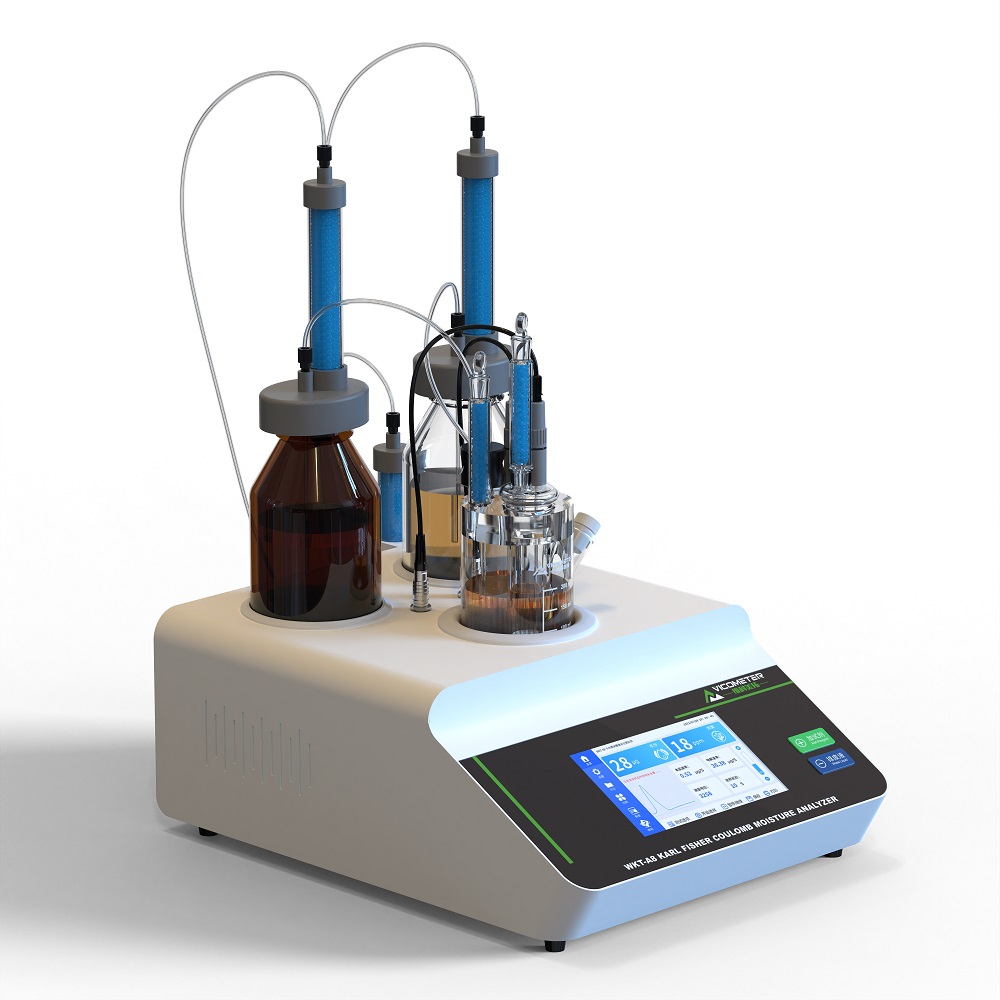
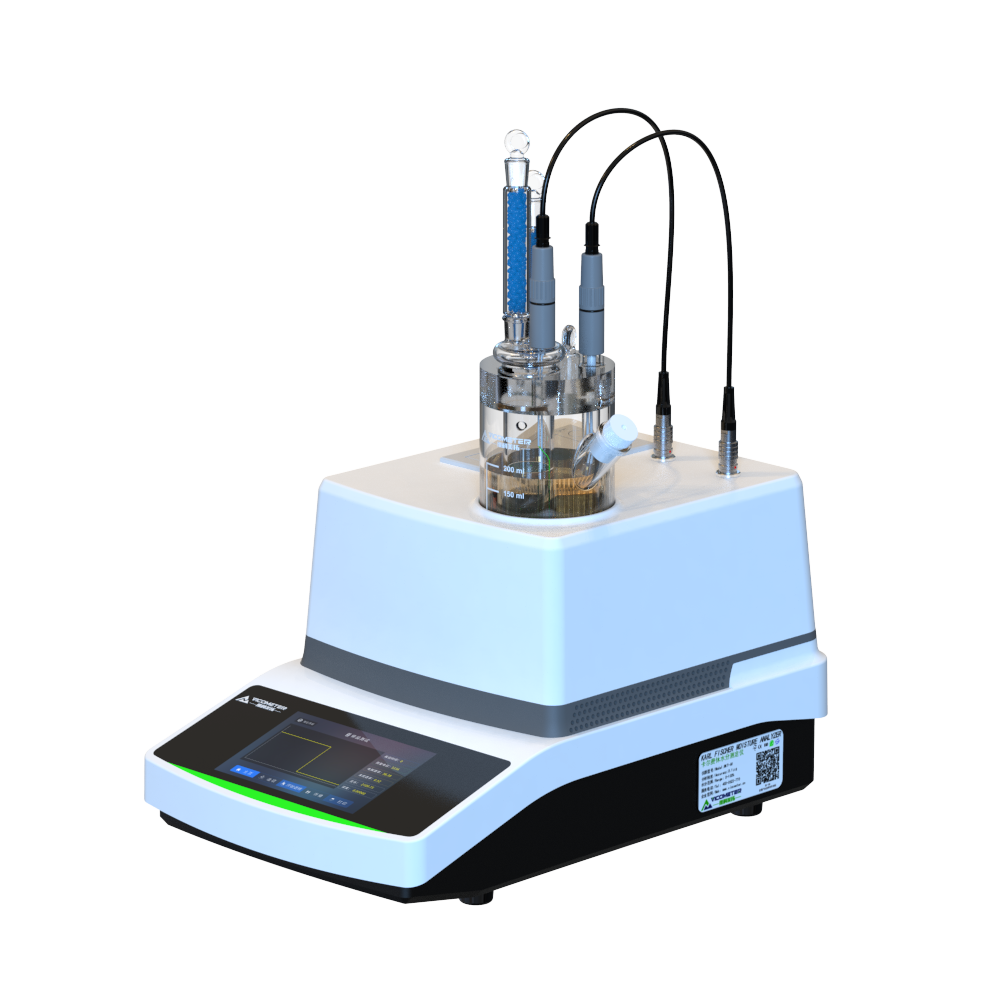
Principle and Development of Karl Fischer Moisture Analyzers
Proposed by Karl Fischer in 1935, this volumetric method is the most specific and accurate for water—now the standard method for many substances.
Its titration and coulometric forms suit many inorganic and organic compounds—the globally recognized classic for rapidly determining moisture in liquids, solids, and gases, widely used in petroleum, chemicals, power, pharmaceuticals, pesticides, and research.
Beyond a good instrument, check for interferences, size samples properly, and operate carefully. In 1935 Karl Fischer proposed the volumetric (visual) method of GB6283 for colorless liquids; the electrolytic method followed, and combining the coulometer with volumetric analysis produced the coulometric method of GB7600. Karl Fischer thus divides into volumetric and coulometric branches, both standard methods for calibrating other methods and instruments.
Moisture Reaction Principle
When iodine oxidizes sulfur dioxide, a certain amount of water participates in the reaction: I2+SO2+2H2O=2HI+H2SO4 The reaction is reversible; an alkaline substance must be added, and the reagent must include methanol or another solvent with active OH groups so pyridine sulfuric anhydride converts into stable methyl sulfuric acid pyridinium hydrogen.

In KF coulometric titration, the required iodine is generated directly by electrolysis; water content is calculated from the charge-iodine relationship. When free iodine appears, the voltage across the Pt indicator electrodes drops sharply—marking the endpoint.
Electrolysis Reaction (Faraday's Law of Electrolysis)
During electrolysis, the electrode reactions are:
Anode: 2I--2e→I2
Cathode: I2+2e→2I- ,2H++2e→H2↑
From the above, 1 mol of iodine oxidizing 1 mol of sulfur dioxide requires 1 mol of water. Electrolyzing 1 mol of iodine requires 2×96493 C (Faraday constant 9.6493×10000 C/mol), consuming 18 g of water.
From Faraday's law of electrolysis, M×10-6/18=Q×10-3/2*9.6493, so M=Q/10.722
Where: W--moisture content (μg); Q--electrolysis charge (mC); 18--molecular weight of water.
Based on different user requirements, VicoMeter offers the following solutions:
Karl Fischer Trace Moisture Analyzer (Coulometric)
Karl Fischer Moisture Analyzer (Volumetric)
Choose the instrument that suits your needs, or contact VicoMeter customer service directly for advice.
5. Applications of Online Moisture Analyzers in the Food Industry
An online moisture analyzer continuously monitors and displays product moisture; in pharma, microwave and infrared dominate. Installed on site, it enables real-time monitoring, process refinement via historical data, and rapid response to moisture alarms...Learn More About the Principle of Online Moisture Analyzers
Principle of Online Near-Infrared Moisture Analyzers
O-H bonds in water and C-H bonds in organics absorb NIR light at specific wavelengths; reflected energy is inversely proportional to absorbing molecules. The analyzer tracks NIR energy changes at a specific wavelength based on water's absorption.
Water molecules vibrate at specific energy bands—O-H bonds stretching, contracting, twisting. NIR bands are especially strong for water and easy to generate, filter, and detect; moisture-measuring wavelengths stay within 1-2.5 μm.
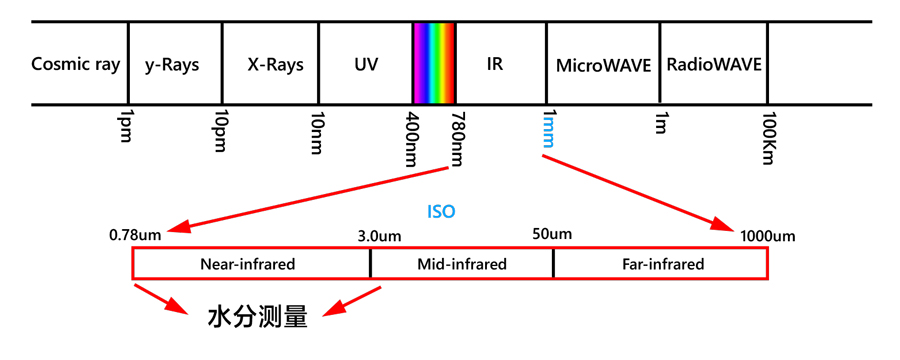
Absorption depends on water molecules encountered and absorption strength—proportional to moisture. As a reflectance method it is also affected by the material's reflectance and absorption; NIR measurement is non-destructive, non-contact, and real-time.
Working Principle of Online Near-Infrared Moisture Monitoring Systems
Multiple NIR beams focus onto the material surface; reflected beams are received by an advanced optical detection system with an embedded high-performance DSP chip for fast processing, storage, and display—outstanding accuracy and stability.
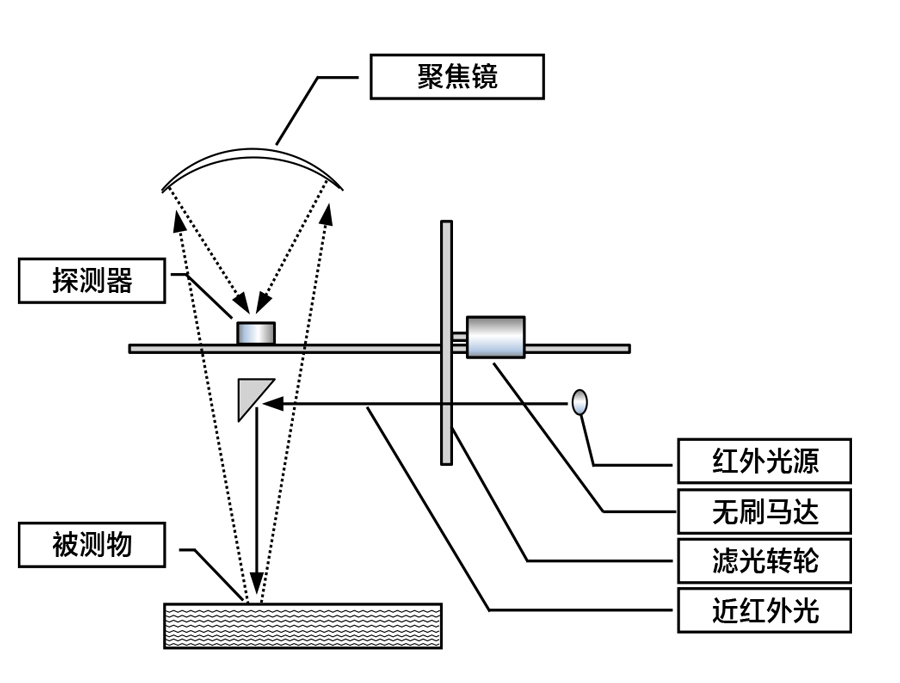
Many materials absorb infrared at specific wavelengths only; at least two are selected—a reference wavelength (not absorbed by material or water) and a measurement wavelength (absorbed by water only).
Precision filters on a rotating wheel pass reference and measurement pulses alternately onto the sample; the two timed pulses reflect to a detector as two signals. The reference shows expected reflection; the measurement is attenuated by water absorption. Combined into a ratio, differences from other moisture levels are proportional to moisture differences.
The signal strengths of the two channels combine into: R/M X M1/R1=ratio
Where: R--reference channel of the product beam
M--measurement channel of the product beam
M1--measurement channel of the compensation beam
R1--reference channel of the compensation beam
If drift occurs, M and M1 shift equally, canceling out in the ratio and preserving stability.
Principle of Online Microwave Moisture Analyzers
Microwave attenuation and phase shift depend on the medium's dielectric constant and loss tangent—far higher for polar water than ordinary media. Moisture is calculated from received attenuation and phase shift.
Microwaves penetrate fully, measuring all physical moisture—surface and internal—with high accuracy unaffected by color or structure. Applications span coal, sinter mixes, iron ore, chemicals, bauxite, nickel ore, sugar, tobacco, bagasse, grain, silicon, wood, wool, food, sand, polymers, cotton, and other non-conductives.
A Detailed Look at Online Microwave Moisture Analyzers
The probe measures 150-200 mm deep, analyzing total (core and surface) moisture; deep penetration means surface dirt does not matter.
The variation of relative permittivity is the key principle; simply:
Water's εr≈80 versus ~1-10 for most materials (sand/gravel 3-4)—a large measurable difference.
Moisture is measured directly from this difference and output as a mass-percentage standard signal.
In other words: the more water a material contains, the closer its relative permittivity εr approaches 80.
Signals are obtained as material passes the sensor—even on fast lines; stationary bulk materials can also be measured.
Based on different user needs, we offer the following solutions:
NIR Online Moisture Meter
Online Microwave Moisture Analyzer
Choose the instrument that suits your needs, or contact VicoMeter customer service directly for advice.
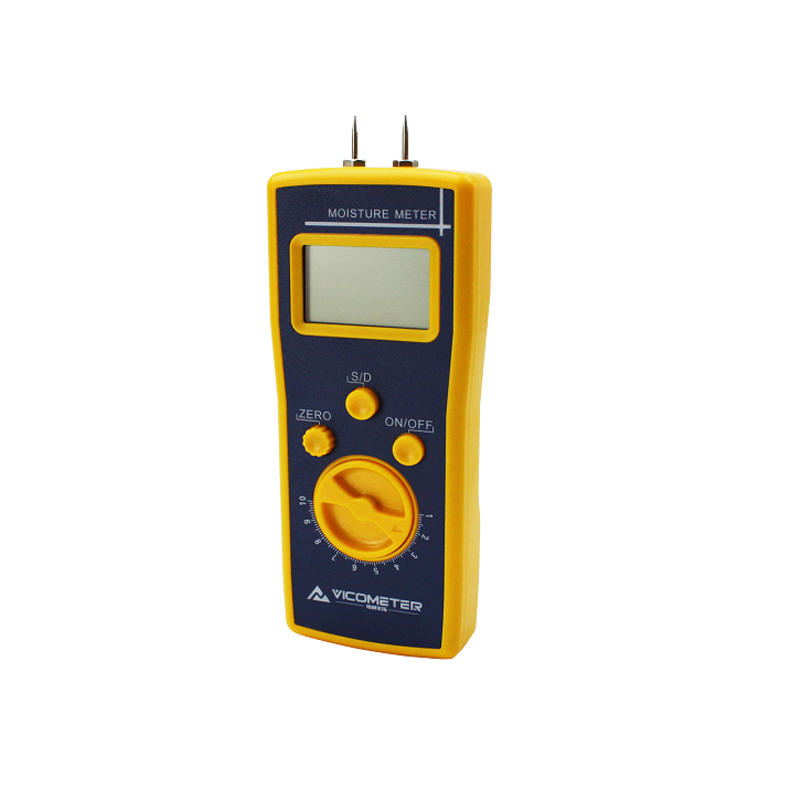
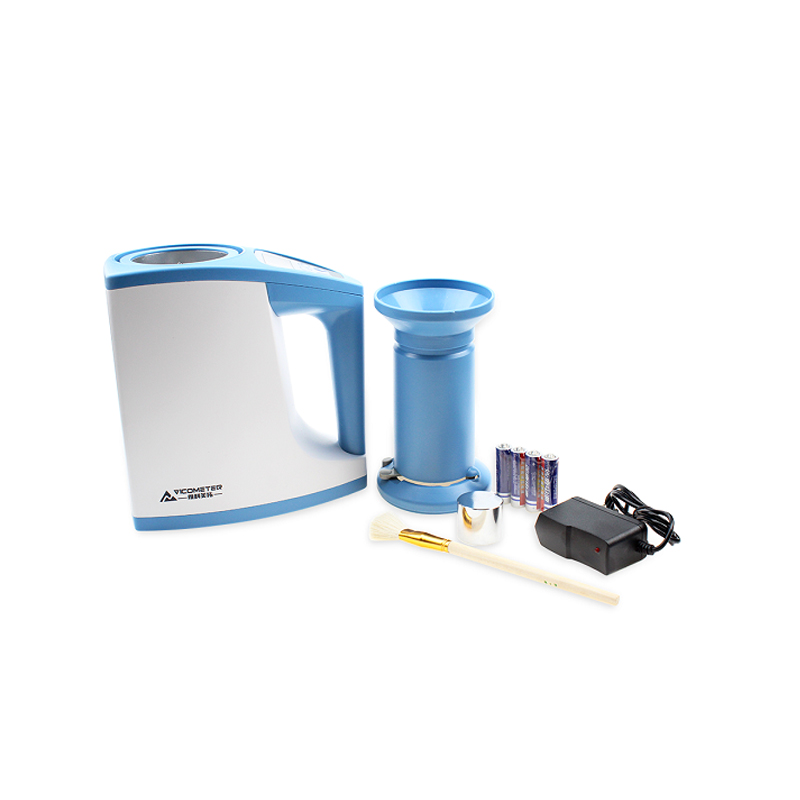
6. Applications of Portable Moisture Analyzers in the Food Industry
A portable analyzer rapidly measures material moisture—less precise than a lab model but far more reliable than a “veteran's” touch. Calibrated units read on site, and out-of-range materials go to the lab for confirmation—popular for incoming materials, production, and spot checks in rubber and plastics.
7. Applications of Dew Point Moisture Analyzers in the Food Industry
Using the resistive-capacitive method, the sensor rapidly displays dew point/humidity in full gas contact. It mounts on lines or travels to the field—no consumables—covering storage/transport ambient gases and process gases/equipment to catch problems early.