With the rapid development of the electric vehicle industry in recent years, quality requirements for lithium-ion batteries, especially power lithium-ion batteries, have risen significantly, and even stricter demands are placed on moisture control in the lithium battery manufacturing process, which markedly affects battery performance. This article discusses the influence of moisture on lithium-ion batteries and how it is managed during production.
The safety of lithium-ion batteries, especially under high temperature, overcharge and short-circuit conditions, has become a technical challenge that must be overcome for large-scale application of power lithium-ion batteries. Whether high temperature, overcharge or short circuit, the root cause of safety incidents is thermal runaway. The battery separator plays an important role, and separator performance is closely related to the solids content of the ceramic slurry.
The interior of a lithium-ion battery is a fairly complex chemical system whose reactions and outcomes are closely related to moisture. Failure to control moisture—or inadequate control—leads to excessive water in the battery, which not only causes decomposition of the lithium electrolyte salt but also severely impairs film formation and the stability of the cathode and anode materials. As a result, the electrochemical characteristics of the battery, such as capacity, internal resistance and product performance, deteriorate noticeably.
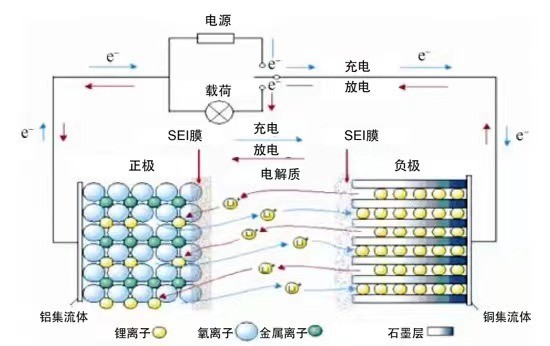
The film mentioned above, the solid electrolyte interface (SEI) film, is a selectively permeable membrane that allows free passage of Li+ ions while blocking electrolyte molecules. The composition of the electrolyte and trace additives significantly affect the formation potential and density of the SEI film, irreversible capacity loss, and internal resistance. As a trace component of the electrolyte, water has a certain influence on SEI film formation and battery performance, mainly manifesting as reduced capacity, shorter discharge time, increased internal resistance, capacity fade upon cycling and battery swelling. Therefore, environmental humidity and the water content of the cathode/anode materials and electrolyte must be strictly controlled during battery manufacturing.
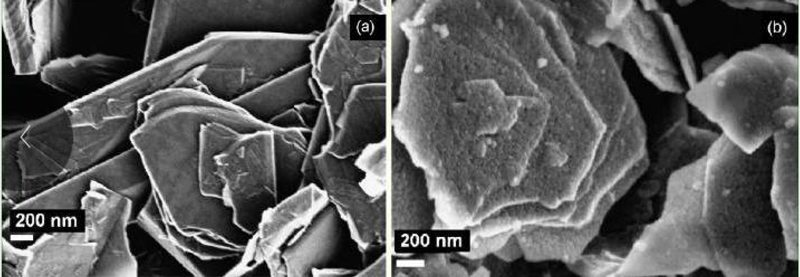
(a) is the pristine electrode material; (b) is the electrode material after one cycle.
The first discharge capacity of a battery decreases as the water content increases. With a constant lithium source, the change in first discharge capacity is governed by two main factors, as follows:
① Formation of the SEI film consumes some Li+, causing irreversible capacity loss. The alkyl lithium carbonate generated in the single-electron reduction can further react with trace water in the electrolyte: 2ROCO2Li+H2O→Li2CO3+CO2+2ROH. Once CO2 is generated, new chemical reactions occur on the anode surface at low potential: 2CO2+2Li++2e→Li2CO3+CO.
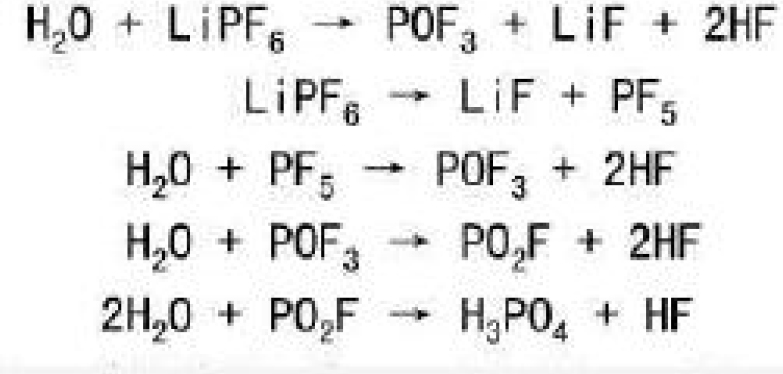
② After the SEI film has formed, in the continued presence of H2O, water promotes the decomposition of LiPF6 in the electrolyte, shortening the discharge time, as follows
Internal resistance tends to rise as the water content of the battery increases. The main causes of internal resistance variation are the following two aspects:
① Differences in the SEI film lead to differences in internal resistance. In the electrolyte solvent system, trace water can form a stable, uniform and dense SEI film dominated by Li2CO3, which has lower internal resistance.
② When the water content exceeds what is required for SEI film formation, POF3 and LiF precipitates form on the SEI film surface, increasing internal resistance.
Capacity fade decreases gradually with increasing moisture content. This is related to the density and uniformity of the SEI film. When the SEI film is uniform and dense, electrolyte solvents cannot easily intercalate into the anode and occupy Li+ intercalation sites, so capacity fade is minimal. Conversely, when the SEI film is locally loose or non-uniform, Li+ intercalation sites are more easily occupied by electrolyte solvents. Li2CO3 is the most important component in forming a dense, uniform SEI film; when the water content in the electrolyte solvent system is excessive, the SEI film becomes locally loose and non-uniform, and capacity fade increases.
Battery swelling occurs mainly because, after the SEI film forms, the presence of water causes LiPF6 to decompose and generate HF gas.
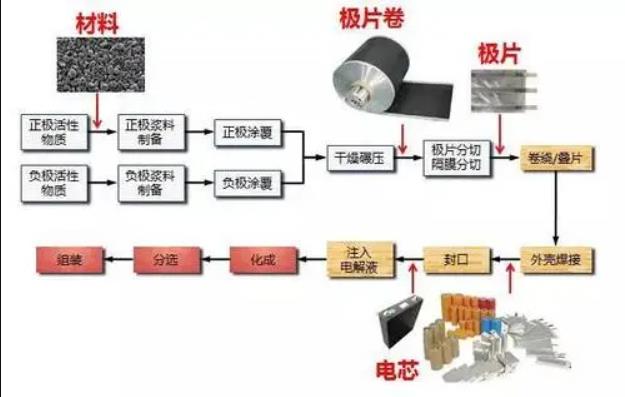
First, an overview of the lithium battery production process:
Moisture sources can basically be divided into the following:
a. Moisture in the air, usually measured as relative humidity. This varies greatly with temperature and weather: it can reach 90% on rainy summer days, around 30% on snowy winter days, around 50% on clear summer days and around 20% on clear winter days.
b. Moisture produced by the human body
Perspiration
Exhaled breath contains moisture—at 2 cm from the nostrils during breathing, humidity reaches 85%
Entering the workshop before drying off after washing up
Bringing wet items such as umbrellas and raincoats into the workshop after rain
c. Moisture carried by materials
Packaging materials (especially cardboard boxes), paper towels and cleaning rags all have very high water content
d. Water leakage from equipment and facilities
Equipment leaks, such as laser welding internal circulation water leaks, and air conditioning or dehumidifier leaks
New factory lime walls and floors have high water content and slowly release water vapor
a. Cathode and anode materials
Cathode and anode active materials are mostly micron- or nano-sized particles that readily absorb moisture from the air and deliquesce. Cathode materials generally have a high pH—especially Ni-rich ternary or binary materials, which also have a large specific surface area and readily absorb and react with moisture on the surface.
b. Electrolyte
The solvent structure of the electrolyte contains strongly electronegative carbonyl groups and metastable double bonds, which readily interact with polar H2O molecules to form complexes or react to form the corresponding alcohols; the higher the temperature, the faster the reaction. The lithium salt solute in the electrolyte is also hygroscopic and reacts with water.
c. Separator
Separator film is also a porous plastic film with high water absorption. Since moisture generally does not chemically react with the separator and can be largely removed by baking, separators are rarely subject to strict moisture control.
Based on the above, the moisture content of materials is one of the main sources of water in cells, and the higher the ambient humidity, the more readily battery materials absorb moisture from the air. Conversely, the better the humidity control, the more limited moisture absorption becomes. A recommended humidity control hierarchy for lithium battery workshops is as follows (for reference only; humidity control should be implemented according to each battery manufacturer's actual conditions):
Workshop with relative humidity ≤30% (e.g., mixing, coating machine head and tail, etc.)
Workshop with relative humidity ≤20% (e.g., calendering, electrode preparation, baking, etc.)
Workshop with relative humidity ≤10% (e.g., stacking, winding, assembly, etc.)
Workshop with dew point ≤-45°C (e.g., cell baking, electrolyte filling, sealing, etc.)
Even with the above humidity gradient control, the residence time of each process step must also be controlled.
In the calendering and electrode preparation workshop, although the battery still needs to be baked afterwards, this does not mean electrodes can be left anywhere before baking. Experiments in workshops that have not yet achieved integrated electrode-winding automation show that once electrodes (especially cathodes) absorb moisture, prolonged baking still cannot restore them to their pre-absorption weight—a stubborn residue remains inside the electrode material. Therefore, exposure time in this workshop should also be controlled as much as possible, avoiding stockpiling or using a vacuum dry-atmosphere buffer.
In the cell assembly workshop (stacking/winding, core assembly, etc.): all key raw materials—cathodes, anodes, separators, battery structural components, etc.—are exposed in this workshop for a period of time, so this is the main place where battery materials absorb water. The longer the residence time, the more moisture absorbed; products should therefore spend as little time as possible in this workshop.
In the laser welding workshop (referring here to cells with square aluminum cans; other types such as pouch and cylindrical cells do not have this step, but this type is used as an example): since the battery is not yet sealed at this stage, the waiting time in this workshop must also be controlled to keep the battery's moisture content sufficiently low.
In the workshop transfer corridors (approximately 30-90% humidity, depending on the weather): corridor humidity is generally uncontrolled, and if batteries wait in these areas they will absorb the most moisture. Unsealed batteries and materials must therefore be 100% prevented from being exposed in this area.
In the baking room workshop, humidity control is even more important, because all the moisture absorbed by the battery must be baked out in this step. If it is not, all the problems mentioned earlier will show up in the product. After baking, cells must be transferred to the electrolyte filling room in the shortest possible time; otherwise, they will absorb moisture severely
Currently, many factories use manual transfer between cell baking and the filling workshop. Because the transfer is done manually, it can very likely cause man-made secondary moisture contamination between batches. Strict moisture control would require dry rooms throughout the process, consuming large amounts of energy and greatly increasing costs. Some companies use dry transfer carts, but problems remain. Manual transfer also takes longer, involves many uncontrollable factors, and requires labor costs (labor is expensive now, unlike in the past).
The electrolyte filling room—as everyone in the lithium battery industry knows—is the room where humidity must be controlled most strictly, with the dew point kept below -45°C, or even drier. If this requirement is not met, all previous controls fail: the battery will reabsorb moisture, the electrolyte will absorb moisture during filling, and all previous efforts will be wasted.
In summary, for processes before cell baking, automation is best where possible, to minimize the exposure time of cell cores in the workshop environment. Where automation is truly not possible, WIP and inventory time and storage conditions should be controlled as much as possible to avoid absorbing excessive moisture during the process. As for the filling room, lithium battery companies are already very attentive to humidity and dew point control there, so it needs no further discussion.
The key is the stage from cell baking to electrolyte filling—an area many manufacturers overlook or are reluctant to invest in—which leads to moisture introduction and greatly undermines the work of all preceding processes.
One method currently available to avoid the uncontrolled moisture introduction of manual transfer is tunnel-style vacuum drying.
This method generally consists of three sections: the preheating section, vacuum drying section and cooling section shown above. In the preheating and cooling sections, where materials enter and exit from outside, a nitrogen purge is used to prevent moisture from entering. The preheating section raises the cell material temperature to the baking temperature before it enters the vacuum drying stage. The vacuum drying stage maintains high temperature uniformity, high vacuum and low dew point to ensure that the moisture in the cell material is fully evaporated.
In addition, the processes before and after this stage are automated, enabling dynamic vacuum operation and achieving automated, continuous, low-energy mass production—something manual transfer could never accomplish.
It is understood that BYD, a leader in the new energy industry, already has more than ten automated vacuum drying production lines replacing the traditional pre-filling cell baking method. This is something other companies in the lithium battery industry should consider following.
Loss-on-drying, also called the heated weight-loss method, is a physical method for determining moisture: heating drives off and dries out the water in the material. The traditional and most common approach is the oven method — the sample is dried in an oven, weighed on an electronic balance before and after, and the moisture value calculated by hand... Learn more about the loss-on-drying principle
Based on different user needs, we offer the following solutions:
Halogen moisture analyzers and far-infrared dark-field heating moisture analyzers
Choose the instrument that suits your needs, or contact VicoMeter customer service directly for advice.
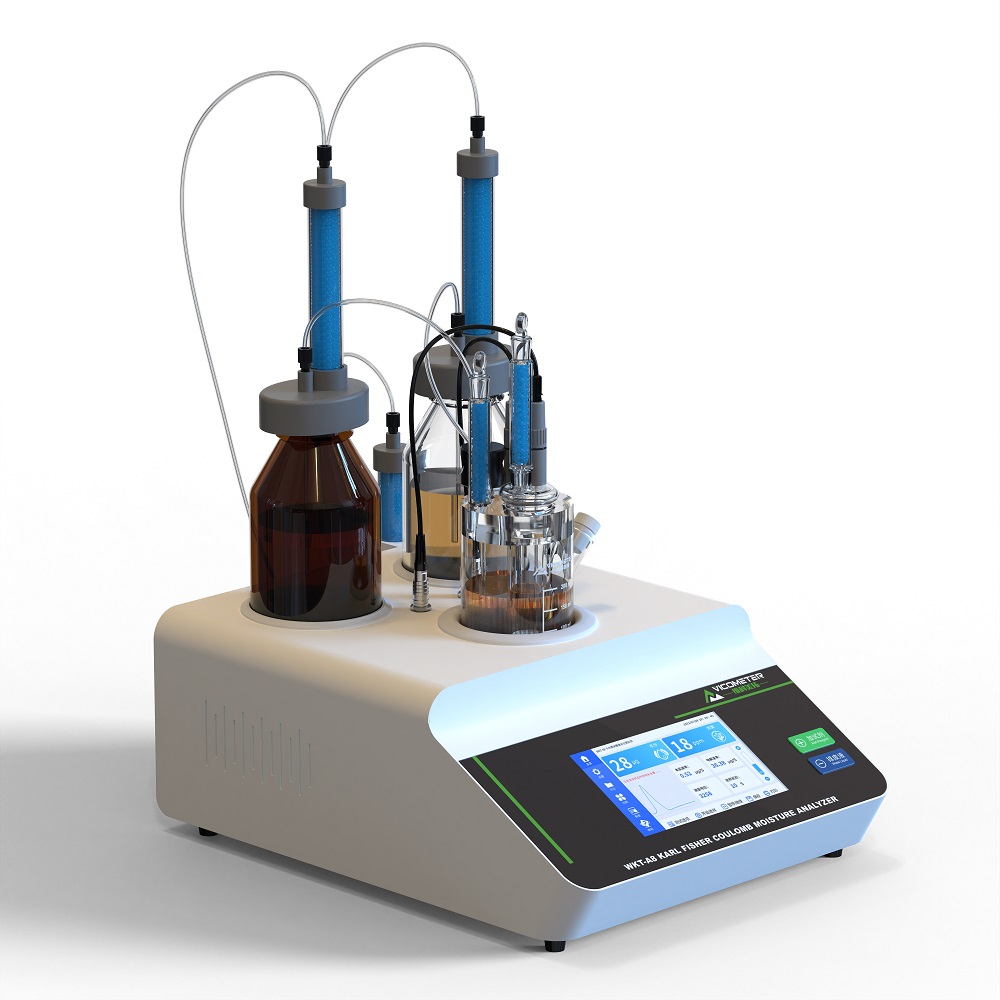
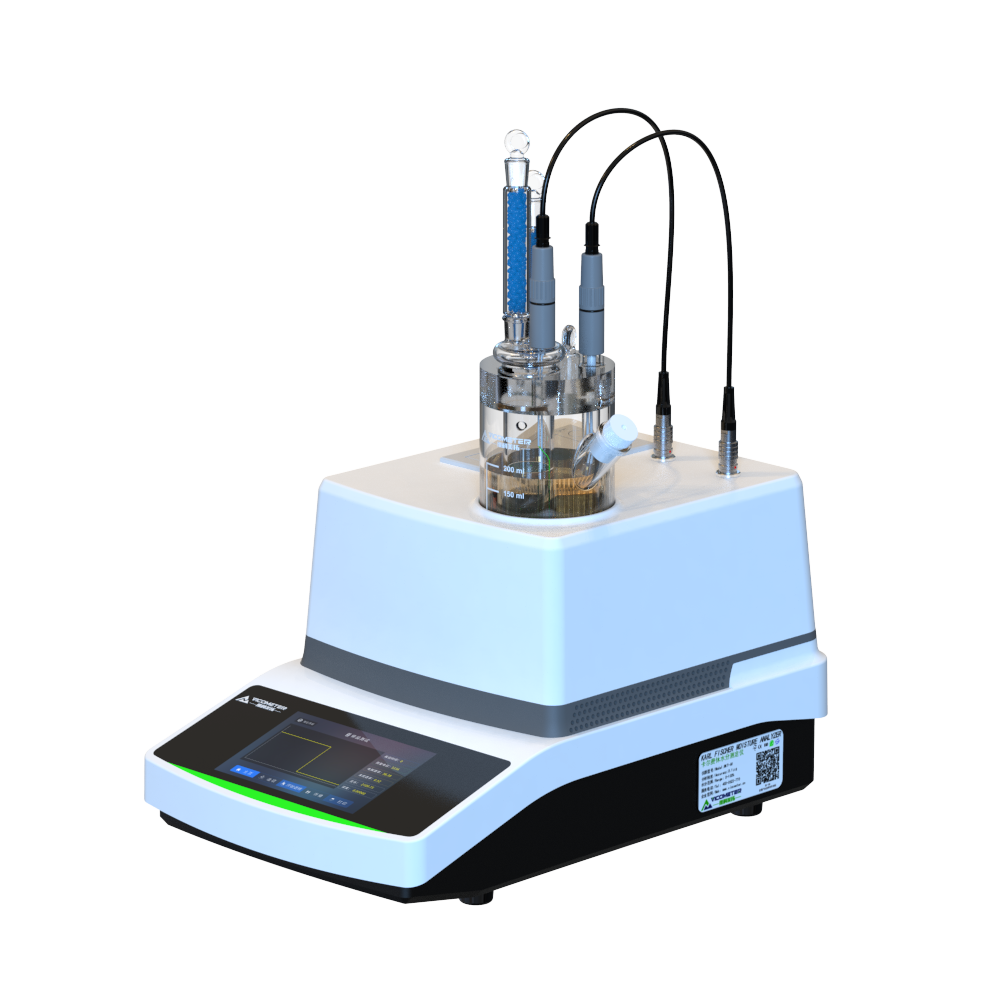
The Karl Fischer method (volumetric and coulometric), proposed by Karl Fischer, is the most water-specific and accurate chemical method; recent improvements raised accuracy and range, making it the standard for many substances...Learn More About the Principle of Karl Fischer Moisture Analyzers
Based on different user requirements, VicoMeter offers the following solutions:
Karl Fischer Trace Moisture Analyzer (Coulometric)
Karl Fischer Moisture Analyzer (Volumetric)
Choose the instrument that suits your needs, or contact VicoMeter customer service directly for advice.
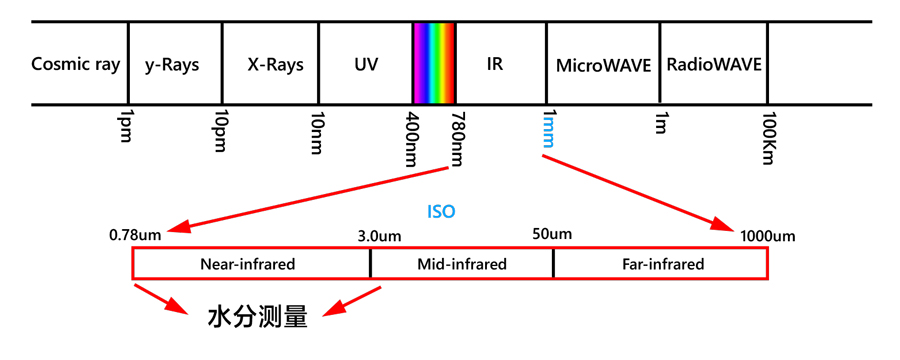
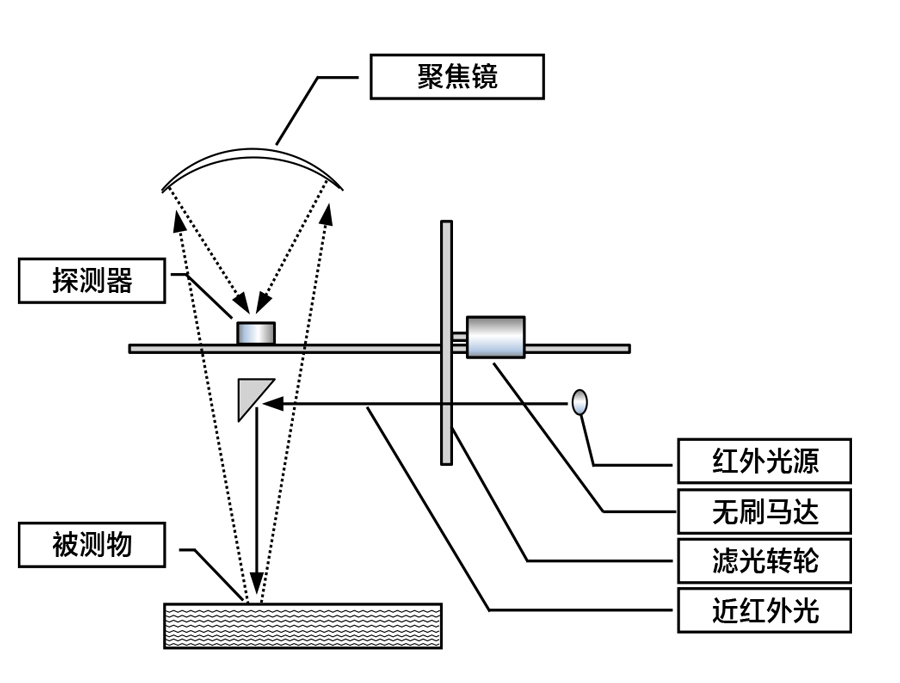
An online moisture analyzer continuously monitors and displays product moisture; in pharma, microwave and infrared dominate. Installed on site, it enables real-time monitoring, process refinement via historical data, and rapid response to moisture alarms...Learn More About the Principle of Online Moisture Analyzers
Based on different user needs, we offer the following solutions:
NIR Online Moisture Meter
Online Microwave Moisture Analyzer
Choose the instrument that suits your needs, or contact VicoMeter customer service directly for advice.
Using the resistive-capacitive method, the sensor rapidly displays dew point/humidity in full gas contact. It mounts on lines or travels to the field—no consumables—covering storage/transport ambient gases and process gases/equipment to catch problems early.
View Details
Hot Products
Recently Viewed Products




Copyright © Jiangsu Victor Instrument Meter Co., Ltd. All rights reserved | Sitemap | Technical Support: VicoMeter Operations Center