

Petroleum products are now used everywhere, and water—one of the quality indicators for petroleum products—strongly affects their quality. It enters during transport and storage, or is absorbed and dissolved from contact with the atmosphere and water.
Water exists in petroleum products mainly in three states: suspended, emulsified, and dissolved.
Suspended: water droplets are suspended in the oil. Suspended water is found mostly in viscous heavy oils and can be removed by heating and settling with air-stirring or by vacuum drying.
Emulsified: water is dispersed in the oil as extremely fine droplets. Because the droplets are so small, this kind of emulsion is even harder to separate from the oil than suspended water.
Emulsified water usually forms during crude production, processing, and refining: violent agitation together with natural emulsifiers in the crude—asphaltenes, resins, naphthenic acids—creates a stable water-in-oil emulsion that is difficult to break and requires special dehydration methods.
Dissolved: water is dissolved in the oil, existing at the molecular level between hydrocarbon molecules in a homogeneous phase. The amount of water that dissolves depends on the chemical composition of the product and on temperature.
In general, paraffins, naphthenes, and olefins dissolve less water, while aromatics dissolve more; the higher the temperature, the more water dissolves. Because the dissolved water in gasoline, kerosene, diesel, and some light lubricating oils is so small, it cannot be detected by the GB/T 260 method. Although tiny in amount, this dissolved water is hard to remove completely. Dissolved water is unavoidable in crude and petroleum products alike; in petroleum analysis, "water-free" is taken to mean no suspended or emulsified water.
(1) Water in light oil products worsens combustion and carries dissolved salts into the cylinders, forming carbon deposits and increasing cylinder wear.
(2) At low temperature, water in fuel freezes, blocking fuel lines and filters and obstructing fuel supply to the engine fuel system.
(3) Water in petroleum products accelerates oxidation and gum formation.
(4) Water in lubricating oil not only corrodes engine parts but also turns to steam on contact with metal parts above 100 °C, destroying the lubricating film.
(5) It accelerates corrosion of metals by organic acids, causing rust; it deactivates additives, worsens low-temperature fluidity, blocks oil lines, and hampers oil circulation and supply.
(6) It also intensifies emulsification of the oil and lowers the dielectric strength of transformer oil.
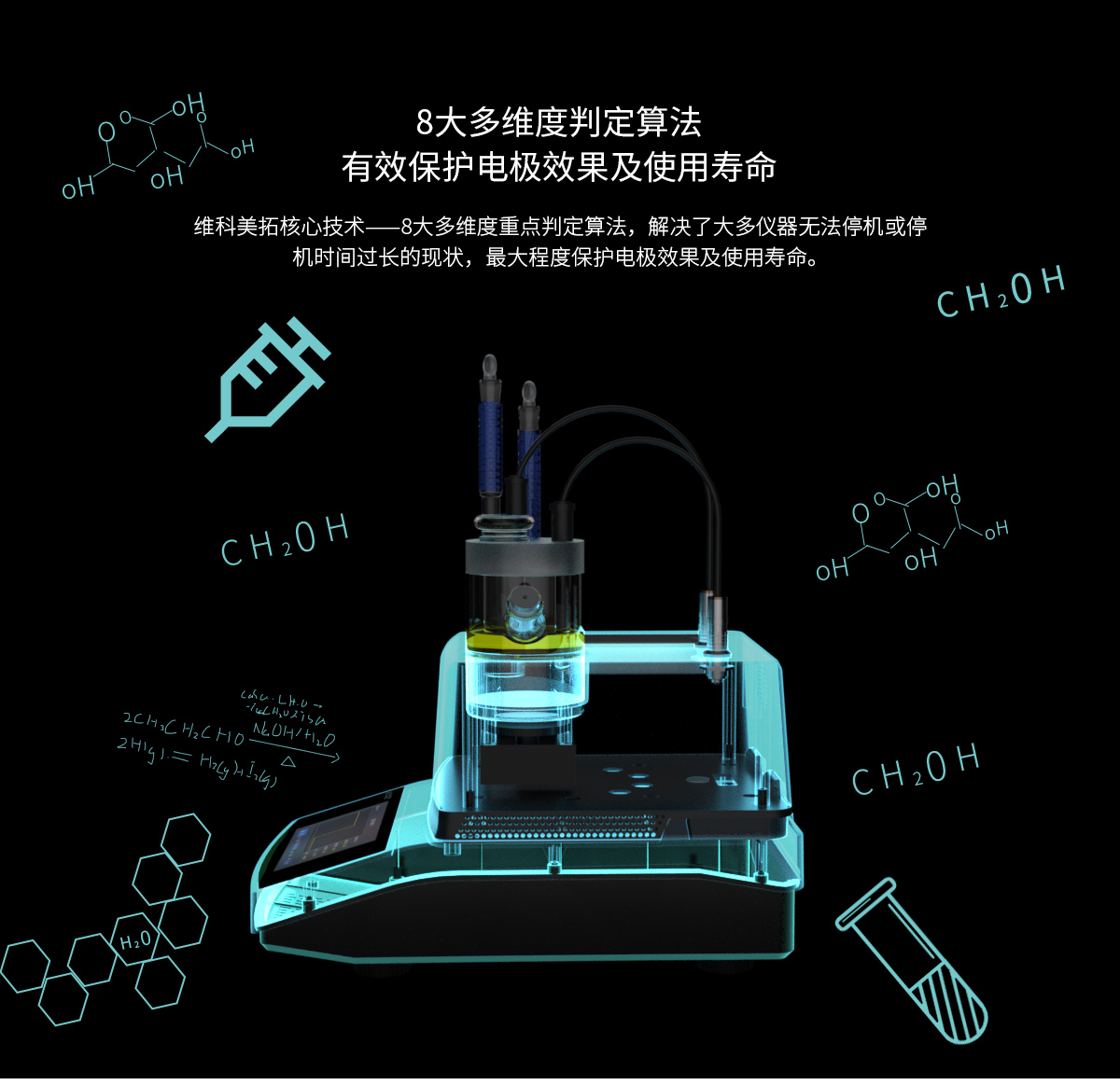
The VicoMeter WKT-A9 Premium Karl Fischer trace moisture analyzer uses the Karl Fischer coulometric (electrolytic) principle to rapidly determine trace moisture in samples, measuring moisture down to 0.001 ppm and determining trace moisture in solids, liquids, and powders within 1 minute. The instrument has a built-in printer, can store 500 data records, and supports real-time query and printing! The newly designed navigation prompts and built-in electronic manual make operation simple. The WKT-A9 complies with multiple national and international moisture measurement standards, with eight built-in moisture calculation formulas and 6 measurement methods to meet the moisture measurement needs of every industry—widely used in chemicals, petroleum, pharmaceuticals, electric power, food, research, and testing.
Recently Viewed Products




Copyright © Jiangsu Victor Instrument Meter Co., Ltd. All rights reserved | Sitemap | Technical Support: VicoMeter Operations Center





























