

China.com.cn Finance, December 20 (Reporter Li Jing) — In recent years, with the improvement of living standards, changing consumption concepts and the drive of new-generation parents toward scientific and refined child-rearing, the infant and toddler snacks and complementary food segment has grown year by year, ushering in explosive growth. The "2020-2024 China Infant Complementary Food Industry In-Depth Research and Investment Outlook Forecast Report" released by China Investment Industry Research Institute shows that China's infant complementary food market was about RMB 10 billion in 2012 and reached RMB 40.4 billion in 2019, with the domestic market maintaining a growth rate of over 10% in recent years. However, as the market grows, industry irregularities are frequently exposed.
Recently, the "Notice on 39 Batches of Non-Compliant Food" issued by the Henan Provincial Market Supervision Administration showed that one batch of salmon and carrot nutritional rice cereal (250g (25g×10 bags)/box, production date: 2020-11-12) sold by Beizhiliang Maternity and Baby Store in Guancheng District, Zhengzhou and labeled as produced by Shanghai Eastwes Children's Food Co., Ltd. (hereinafter "Shanghai Eastwes", Eastwes Children's Food Factory) had a moisture test value of 6.51% versus a standard of no more than 6.0%. The initial testing institution was the Henan Food Inspection and Research Institute, and the re-testing institution was the Henan Product Quality Supervision and Inspection Institute.

Image source: Henan Provincial Market Supervision Administration
The Henan Market Supervision Administration stated that moisture is a physical and chemical indicator and an intrinsic quality factor of food. Product standards for various foods often have clear limits on moisture content, and the moisture level reflects the water content of a product. Proper moisture control can prevent the decomposition, enzymatic deterioration and mildew of functional ingredients or nutrients, helping to maintain stable product quality. Non-compliant moisture in food has no major impact on human health; however, excessive moisture may shorten shelf life, make products prone to mildew, and cause product quality to decline.
It is worth noting that this is not the first time Shanghai Eastwes Children's Food Co., Ltd. has been reported for non-compliant food. As early as 2015, the company was reported for excessive "total plate count".
According to the 2015 food safety supervision sampling notice issued by the Shanghai Food and Drug Administration, the all-functional animal biscuits ("Quanjineng/Eastwes" trademark, 100g/can, production date: 2015/03/21) labeled as produced by Shanghai Eastwes Children's Food Co., Ltd. (Eastwes Children's Food Factory) had a total plate count of 5400 CFU/g versus a standard of no more than 750 CFU/g, and a coliform count of 230 MPN/100g versus a standard of no more than 30 MPN/100g. A rough calculation by the reporter shows both test values were nearly 8 times over the standard.
Data show that excessive total plate count indicates that the product's hygiene condition fails to meet basic hygiene requirements, which will destroy the nutritional content of the food, accelerate spoilage, and cause the food to lose its edible value.
Recently, an administrative penalty decision issued by the Shanghai Pudong New Area Market Supervision Administration showed that in March 2021, Shanghai Aiyingshi E-Commerce Co., Ltd. (hereinafter "Aiyingshi E-Commerce") published advertisements on its Aiyingshi flagship store on JD.com: "Eastwes baby meat floss—pork and beef floss, high-calcium meat floss, baby snacks, fish floss, pork floss, fruit and vegetable pork floss, 100g" and "Little Fresh Meat—mom's meal helper, over 20 years focused on high-quality complementary food for Chinese babies".
The Pudong New Area Market Supervision Administration held that the product actually follows the product standard for cooked meat floss products, not infant canned complementary food, which is misleading. The Shanghai Pudong New Area Market Supervision Administration, citing a violation of Article 4, Paragraph 1 of the Advertising Law of the People's Republic of China — "advertisements shall not contain false or misleading content and shall not deceive or mislead consumers" — fined Aiyingshi E-Commerce RMB 4,500 in accordance with Article 55, Paragraph 1 of the Advertising Law.
It is understood that Eastwes meat floss follows the "product standard for cooked meat floss products", which is the enterprise standard of Shanghai Eastwes Children's Food Co., Ltd. "Q/ABDM0003S-2017", and neither the product standard, name nor packaging is marked with the words "infant and toddler"; the product is merely an ordinary food.
The Shanghai Food and Drug Administration's reply (May 25, 2016) on whether the National Food Safety Standard for Canned Complementary Foods for Infants and Young Children applies to canned meat floss products clearly stated that food produced specifically for infants and young children shall comply with relevant food safety standards for infants and young children. The properties and related indicators of canned complementary foods for infants and young children shall comply with GB10770-2010, National Food Safety Standard — Canned Complementary Foods for Infants and Young Children. Otherwise, the label shall not claim suitability for infants and young children.
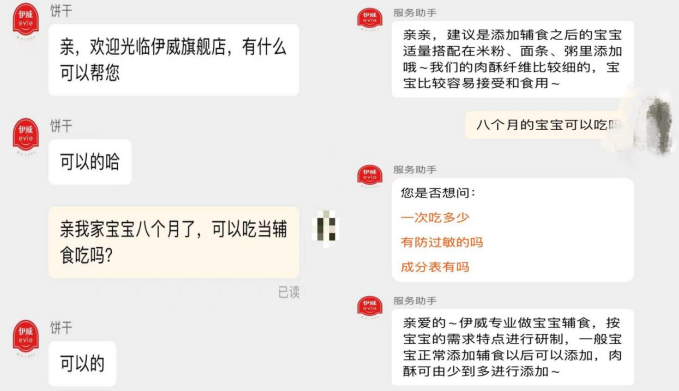
The reporter found on an Eastwes e-commerce platform store that, besides the meat floss, the store also sells a similar product, Eastwes all-functional pork floss, whose executive standard is GB/T 23968 "Meat Floss". When the reporter asked whether this product is an "infant complementary food", the flagship store's customer service replied, "Eastwes specializes in baby complementary food, developed according to babies' needs; it can generally be added after the baby starts complementary feeding normally, and the meat floss can be added from a small amount to more." When the reporter asked, "Can an eight-month-old baby use it as complementary food?", the customer service replied, "Yes.".
Tianyancha information shows that Shanghai Eastwes Children's Food Co., Ltd. was established in December 2008, with legal representative Zhuang Kehang and registered capital of RMB 25.423475 million. Its profile states that since its founding in 1996, Eastwes has been committed to exploring and researching scientific feeding for Chinese infants and young children, and is one of the earlier domestic companies focusing on powdered complementary food for infants and young children, with main products such as organic germ rice cereal, organic noodles and all-functional liver powder.
The reporter learned on an Eastwes e-commerce platform store that only some of the store's products follow infant complementary food standards, while most others follow enterprise standards. For example, "Eastwes Yixiaoxia Original Shrimp Chips" follows national standard GB10136 "Cooked Aquatic Animal Products"; "Eastwes Menghuale Yogurt Melts" follows enterprise standard Q/FJMY 0005S "Freeze-Dried Solid Beverages"; and "Eastwes Menghuale Seaweed Rice Crisps" follows national standard GB17401 "Puffed Food" — all of the above are ordinary foods.
Regarding whether the company has conducted self-inspection on related product quality and advertising issues, the China.com.cn Finance reporter sent an interview letter to Shanghai Eastwes Children's Food Co., Ltd.; no response had been received as of press time.
At present, many ordinary foods on the market claim to be baby snacks or infant and toddler snacks. Industry insiders advise paying special attention to the words "infant and toddler" on food labels and the product standard number when purchasing, and buying as needed.
Compared with ordinary food standards, "infant complementary food standards" are stricter, more comprehensive and more rigorous, with strict limits on raw material requirements, sensory requirements, nutritional composition indicators, contaminant limits, microbial limits, and food and nutritional additives. Infant complementary foods belong to the category of foods for special dietary uses. At present, the national mandatory infant food standards include five categories: "Cereal-Based Complementary Foods for Infants and Young Children" (GB 10769), "Canned Complementary Foods for Infants and Young Children" (GB 10770), "Complementary Food Supplements" (GB 22570), "Infant Formula" (GB 10765) and "Follow-Up Formula for Older Infants and Young Children" (GB 10767), which have a mandatory supervisory effect on infant food manufacturers and help maintain and improve production practices.
Recently Viewed Products




Copyright © Jiangsu Victor Instrument Meter Co., Ltd. All rights reserved | Sitemap | Technical Support: VicoMeter Operations Center





























