Dew Point Meter
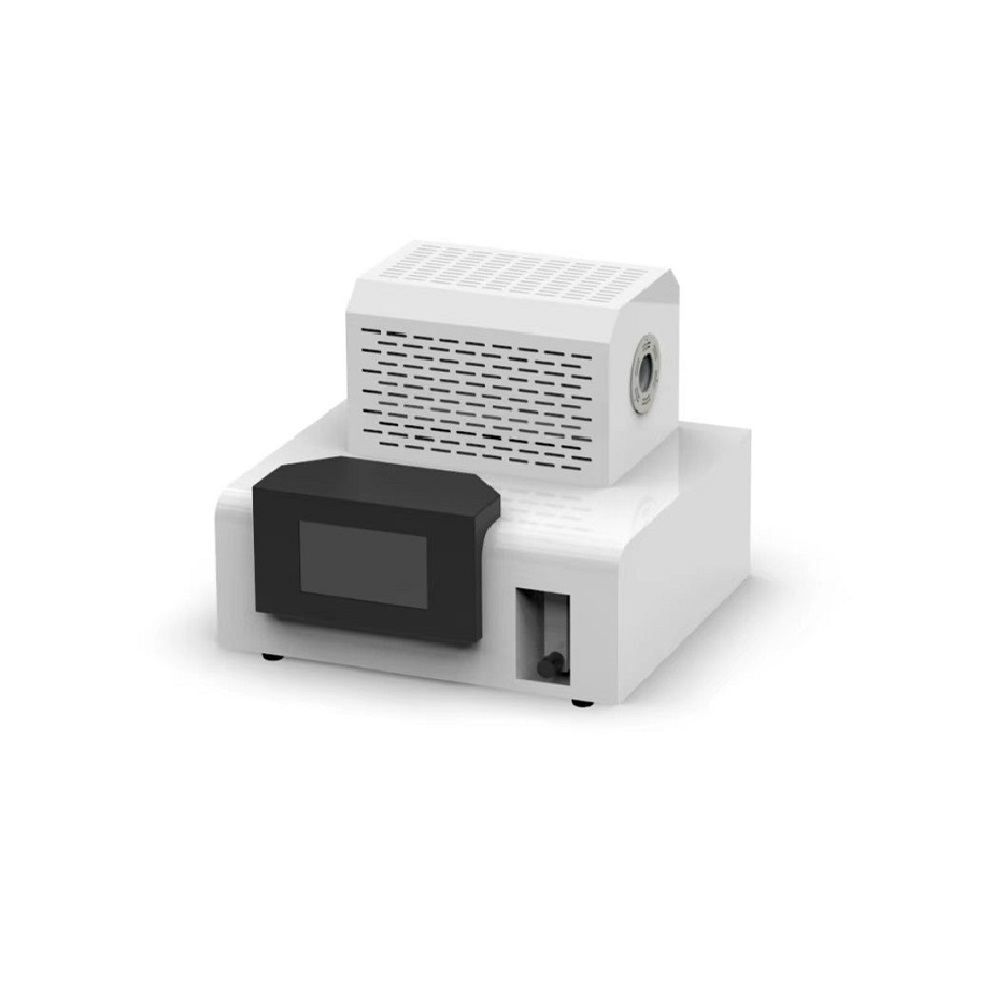
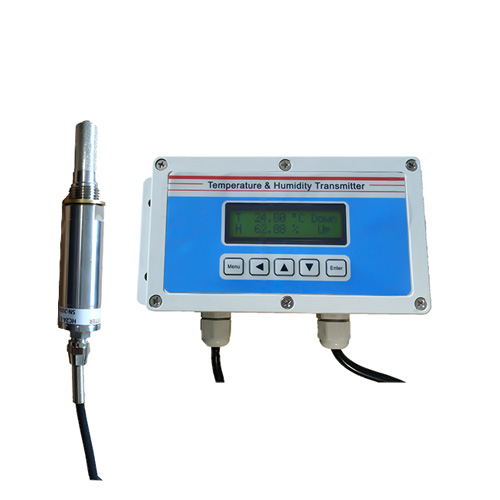
A dew point meter directly measures dew point temperature. It is also called a gas moisture detector, gas dew point meter, dew point hygrometer, precision dew point meter, intelligent trace moisture meter, or gas moisture meter.

Dew Point Meter
(Click image to enlarge)
A dew point meter is an instrument that directly measures dew point temperature; it is also called a gas moisture detector, gas dew point meter, dew point hygrometer, precision dew point meter, intelligent trace moisture analyzer, or gas moisture analyzer. It is widely used in power plants, metallurgy, scientific research, health quarantine, grain storage, medical devices, environmental testing and other production processes. It is suitable for measuring various acidic and alkaline gases and is not affected by hydrogen, sulfur hexafluoride, carbon dioxide, methane, oxygen and other gases.
A mirror is cooled in the humid sample air until dew droplets (or ice crystals) appear on its surface; the average mirror temperature measured at that instant is the dew (frost) point temperature. This method offers high humidity measurement accuracy, but requires a mirror with very high surface finish, a highly precise temperature control system, and a highly sensitive optical detection system for the droplets (ice crystals). During use, the sampling air lines must be kept clean, otherwise impurities in the lines will absorb or release moisture and cause measurement errors.

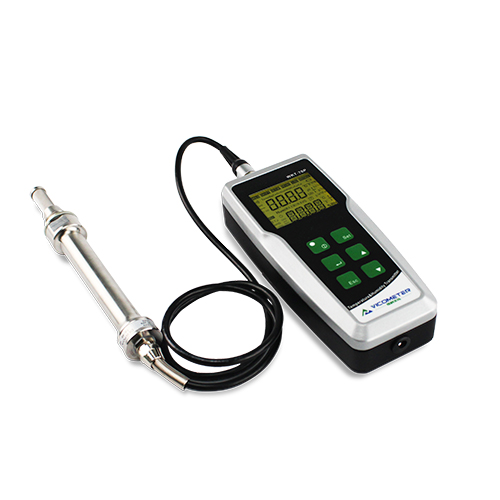
Portable Dew Point Meter
In winter, we often see a common phenomenon: because the outdoor temperature is low, the warm humid indoor air condenses on window glass, making it foggy. If we observe more carefully and turn on a dehumidifier indoors to gradually remove the moisture, we find that even though the outdoor temperature stays the same, the condensation on the window glass slowly disappears and the glass becomes clear and transparent again.
If the outdoor temperature drops further, then when it falls to a certain level, a foggy dew layer will still form on the window glass even though the dehumidifier has made the indoor air very dry. This shows that the condensation temperature on the glass is related to the water content of the ambient atmosphere. Further research reveals a one-to-one correspondence: each condensation temperature (which we call the dew point temperature) corresponds to a specific water content value of the ambient atmosphere.
Dew point can simply be understood as the temperature at which the water vapor content in a gas reaches saturation; it is one way of expressing the absolute humidity of a gas. Thus, dew point temperature is a unit system for measuring gas moisture content, and a dew point analyzer is an instrument that measures the absolute moisture content of a gas based on this unit system.
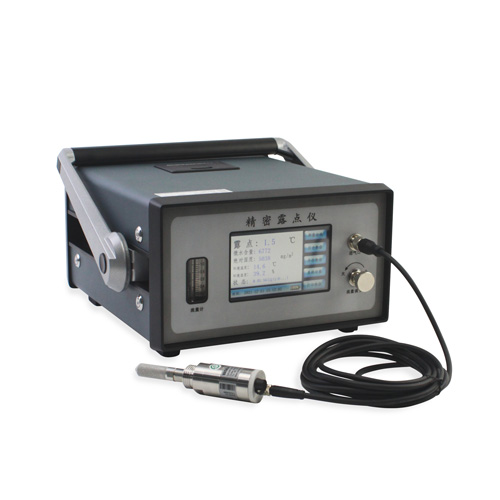
Precision Dew Point Display
In summary, dew point meters measure gases, which generally serve three purposes: power gas, process gas, and ambient gas.
Power gas serves as a power source for pneumatic instruments and equipment, and is widely used in industrial fields and industrial sites with special explosion-proof requirements.
Process gas serves as a process medium — participating in process reactions, acting as a protective gas, or serving as a calibration gas — and is widely used in corresponding production processes in modern industry. Ambient gas, as a process environment, is widely present in relevant process environments of civil and military industries.
The dew point meter was born out of the need for enterprises to control the moisture content in gases. To obtain high-quality products or keep equipment running properly, industries such as petrochemicals, power, electronics, aerospace, metallurgy, and textiles must strictly control humidity. As technology advances and product quality improves, the requirements for humidity control become ever higher.
Humidity measurement has thus gradually become an emerging technical field. In 1986, China formally established the Humidity and Moisture Professional Committee and held multiple academic exchanges; metrological verification regulations for humidity were gradually established. According to relevant regulations, humidity is defined as the water vapor content in a gas, with common units including g/L, ppm, mmHg, dew point, and relative humidity. Conventionally, a dew point of -20°C is the boundary dividing measured gases into high-humidity gases and low-humidity gases (i.e., trace moisture). Here we focus on the measurement of low-humidity gases.
Gases with different moisture contents condense on a mirror at different temperatures. Using photoelectric detection technology, the dew layer is detected and the condensation temperature is measured, directly displaying the dew point. Mirror cooling methods include semiconductor cooling, liquid nitrogen cooling, and high-pressure air cooling. The chilled mirror dew point meter uses a direct measurement method; with accurate dew detection, efficient mirror cooling, and precise condensation temperature measurement, it can be used as a reference dew point meter. Internationally, the highest accuracy reaches ±0.1°C (dew point temperature), with general accuracy within ±0.5°C.
Using hydrophilic or hydrophobic materials as the dielectric to form a capacitor or resistor, the dielectric constant or conductivity changes accordingly when moisture-laden gas flows past. By measuring the capacitance or resistance at that moment, the gas moisture content can be determined. Such sensors, designed on the dew point unit system, constitute the electrical sensor dew point analyzer. Internationally, the highest accuracy reaches ±1.0°C (dew point temperature), with general accuracy within ±3°C.
Utilizing the property of materials such as phosphorus pentoxide to decompose into polar molecules after absorbing moisture, thereby accumulating charge on electrodes, the electrolytic trace moisture analyzer is designed on an absolute moisture content unit system.
Utilizing the property that a crystal's oscillation frequency changes when wetted, crystal oscillation dew point meters can be designed. This is a relatively new technology that is not yet fully mature. Related products exist abroad, but with poor accuracy and very high cost.
Utilizing the infrared absorption characteristics of moisture in gases, infrared dew point meters can be designed. Such instruments have difficulty measuring low dew points, mainly because the peak detectivity of infrared detectors cannot yet reach the magnitude of trace water absorption, and other gas components interfere with infrared absorption. However, this is a very new technology of great significance for non-contact online monitoring of moisture content in ambient gases.
Every water molecule has its natural vibration frequency. When it enters the gaps of a semiconductor lattice, it resonates with the charge-excited lattice, and the resonance frequency is proportional to the number of moles of water. The resonance of water molecules causes the semiconductor junction to release free electrons, increasing the lattice conductivity and reducing impedance. Semiconductor dew point meters designed on this principle can measure trace moisture down to -100°C dew point.
A classic measurement method. The sample gas flows through a desiccant, which absorbs its moisture; the absorbed water is precisely weighed, and the ratio to the sample gas volume gives the gas humidity. The advantage is high accuracy, with a maximum permissible error of up to 0.1%. The disadvantage is the difficulty of practical operation — a sufficient mass of absorbed water (generally no less than 0.6 g) must be obtained, which is especially difficult for low-humidity gases and requires increasing the sample gas flow, resulting in longer measurement time and larger errors (the measured humidity is not an instantaneous value). Therefore, this method is only suitable for gases with dew points above -32°C, and few instruments on the market rely purely on this method.
From the above analysis, the key to the gravimetric method is how to precisely measure the moisture absorbed by the desiccant. Since direct measurement is difficult, two indirect methods for measuring absorbed water content have been derived.
The moisture absorbed by the desiccant is electrolyzed into hydrogen and oxygen in an electrolytic cell and discharged; the electrolysis current is proportional to the moisture content, so detecting this current yields the sample gas humidity. This method overcomes the drawbacks of the gravimetric method, with a measuring range down to below -80°C, good accuracy, and low cost. The disadvantages are that the electrolytic cell gas path needs a long drying time before use, and it has high requirements for gas corrosiveness and cleanliness.
The desiccant in the gravimetric method is replaced with a hygroscopic quartz crystal. Since the crystal's vibration frequency varies with the mass of absorbed moisture, the sample gas and a standard dry gas are passed over the crystal, producing different vibration frequency differences △f1 and △f2; the sample gas humidity is obtained by calculating the difference between the two frequencies. This method has the same advantages as the electrolytic method and requires no drying before use.
Also a classic measurement method. The sample gas flows past the condensation mirror in the chilled mirror chamber; through isobaric cooling, the sample gas reaches saturated condensation (droplets form on the mirror), and the mirror temperature at that moment is the sample gas dew point. Its main advantage is high accuracy — with semiconductor cooling and photoelectric detection, uncertainty can even reach 0.1°C. The disadvantages are slow response, especially below -60°C dew point where equilibrium may take several hours, and high requirements for sample gas cleanliness and corrosiveness; otherwise, photoelectric detection is affected or 'false condensation' causes measurement errors.
Portable Dew Point Meter
A continuously improving humidity measurement method. A high-purity aluminum rod is surface-oxidized into an ultra-thin aluminum oxide film, over which a porous mesh gold film is plated; a capacitor forms between the gold film and the aluminum rod. Due to the water-absorbing property of the aluminum oxide film, the capacitance changes with the moisture content of the sample gas; measuring this capacitance yields the gas humidity. The main advantages are a lower measuring range, even down to -100°C, and very fast response — reaching 90% from dry to wet within one minute — making it suitable for field and rapid measurements. The disadvantages are poorer accuracy, with uncertainty typically ±2~3°C, and severe aging and drift, requiring calibration every 3-6 months. However, with continuous efforts by manufacturers, this method is being steadily improved — for example, sensor stability has been greatly enhanced through material and process improvements, and saturated linearity has been achieved through response curve compensation, solving the automatic calibration problem.
Dew point meters (humidity instruments) use a wide variety of measurement methods, with great differences in performance and price. Choosing the right dew point meter for your needs is of paramount importance — besides performance and price, you should also consider the application scenario and the type and corrosiveness of the gas being measured. We list some basic principles below; on this basis, you are also welcome to consult VicoMeter's experts.
1) National humidity reference: Given the high accuracy requirements and ideal sample gas, a chilled mirror dew point meter should generally be selected.
2) Enterprise reference or laboratory analysis: If high measurement accuracy is required, a chilled mirror instrument is recommended.
3) Field testing: An impedance/capacitance instrument or a chilled mirror instrument may be selected.
4) Continuous online monitoring: If accuracy requirements are relatively modest, an impedance/capacitance instrument is recommended.
5) Explosion-proof natural gas measurement: The petrochemical and natural gas industries require explosion-proof treatment, so a dew point meter with specific intrinsic safety explosion protection is needed.
6) Dew point measurement in the air separation industry: The air separation industry generally requires very low moisture content, with dew points below -70°C (1 ppm level). In principle, chilled mirror, electrolytic, and thin-film dew point meters cannot measure gases below -80°C, so an impedance/capacitance dew point meter is the more suitable choice.
Related Products
Recently Viewed Products




Copyright © Jiangsu Victor Instrument Meter Co., Ltd. All rights reserved | Sitemap | Technical Support: VicoMeter Operations Center