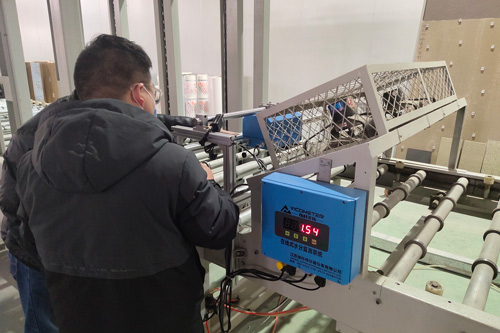
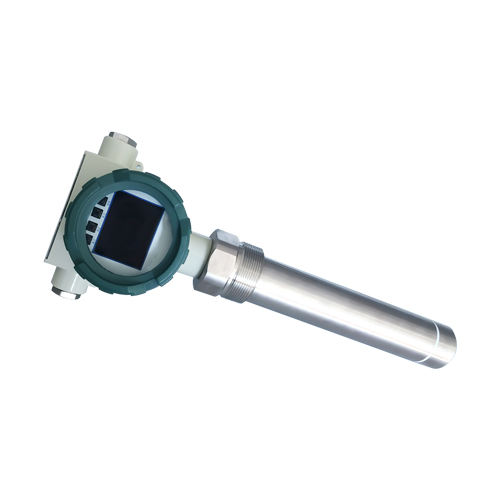
Online Moisture Analyzer
An online moisture analyzer continuously monitors product moisture during production and displays it in real time. It is also called an online moisture monitor or online moisture monitoring system. The market mainly offers near-infrared (NIR) and microwave online moisture analyzers.

Online Moisture Analyzer
(Click image to enlarge)
An online moisture analyzer is an instrument that continuously monitors product moisture during production and displays it in real time; it is also called an online moisture monitor or online moisture monitoring system. The current market mainly offers near-infrared (NIR) online moisture analyzers and microwave online moisture analyzers. As the instruments evolve, online moisture monitors are becoming increasingly intelligent and user-friendly — with features such as upper/lower limit exceedance alarms, data logging, and uploading to user management platforms — helping enterprises maintain stable production and playing a vital role in production activities.
According to on-site production conditions, online moisture analyzers can be installed in various ways, such as non-contact installation (e.g., over conveyor belts), insertion installation (e.g., in tanks), communicating-vessel installation, and in-pipe installation.
Online Near-Infrared Spectroscopy
(Click image to enlarge)
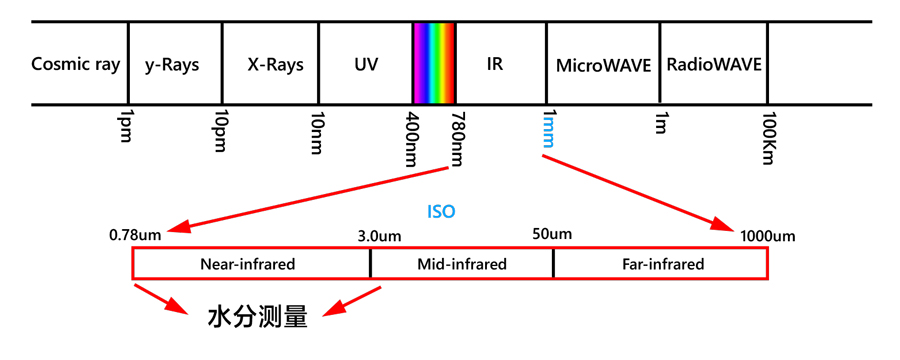
O-H bonds in water and C-H bonds in organics absorb NIR light at specific wavelengths; reflected energy is inversely proportional to absorbing molecules. The analyzer tracks NIR energy changes at a specific wavelength based on water's absorption.
Water molecules are not static: they vibrate when they encounter specific energy bands. The bonds between the two hydrogen atoms and the oxygen atom in a water molecule stretch, contract, or twist in other ways. External energy is required to induce these vibrations, and the required energy spans specific bands across the electromagnetic spectrum. In different parts of the spectrum, some absorption bands are very strong while others are very weak.
WKT-R-50ZS Online Near-Infrared Moisture Analyzer
In the near-infrared region of the spectrum, these bands are particularly strong for water molecules, and the instrument can more easily emit, filter, and receive this energy. Specific wavelengths of near-infrared light energy are used to deliver the right amount of energy to the moisture in the product being measured. The wavelengths generally used for moisture measurement remain in the 1 to 2.5 micron range.
Absorption depends on water molecules encountered and absorption strength—proportional to moisture. As a reflectance method it is also affected by the material's reflectance and absorption; NIR measurement is non-destructive, non-contact, and real-time.
Working Principle of the Online Near-Infrared Moisture Analyzer
(Click image to enlarge)
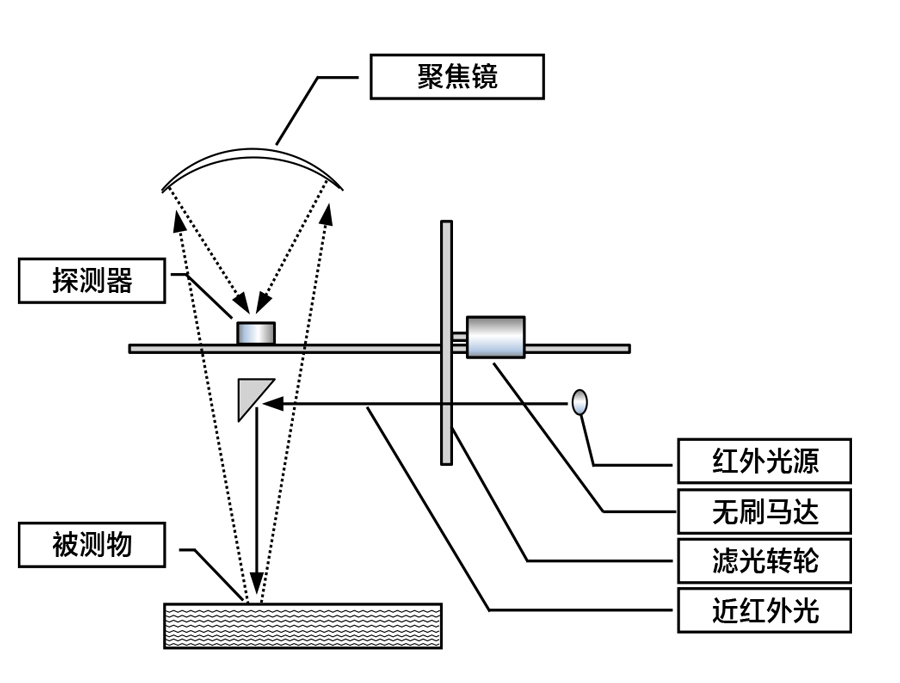
Multiple NIR beams focus onto the material surface; reflected beams are received by an advanced optical detection system with an embedded high-performance DSP chip for fast processing, storage, and display—outstanding accuracy and stability.
Many materials absorb infrared at specific wavelengths only; at least two are selected—a reference wavelength (not absorbed by material or water) and a measurement wavelength (absorbed by water only).
The online infrared moisture meter uses precision infrared filters mounted on a rotating wheel. This arrangement allows pulses of reference light and measurement light to pass alternately through the filters. The retained beams are focused onto the sample under test.
First the reference light is projected onto the sample, then the measurement light. These two time-sequenced light energy pulses are reflected back to a detector and converted into two electrical signals. The reference channel indicates the expected amount of reflected energy. Part of the measurement channel is absorbed by water molecules, so its energy is attenuated. The two signals are combined to form a ratio. The difference between this ratio and ratios obtained from samples of known moisture levels is proportional to the difference in moisture content.

WKT-R-150ZS Online Near-Infrared Moisture Analyzer
The signal strengths of the two channels combine into: R/M X M1/R1=ratio
Where: R--reference channel of the product beam
M--measurement channel of the product beam
M1--measurement channel of the compensation beam
R1--reference channel of the compensation beam
If drift occurs, M and M1 shift equally, canceling out in the ratio and preserving stability.

Probe Mounting Height
(Click image to enlarge)
Online near-infrared moisture monitoring systems are often installed above conveyor belts in production workshops. The instrument should be mounted at a safe measuring position where the material will not touch the probe. The probe mounting height and orientation are shown in the figure on the right (mounting height: 250±100mm). The probe is mounted over an uninterrupted flow of material, such as on a conveyor belt or vibratory conveyor. Note that the material must have sufficient depth — at least 10mm thick (15mm or more recommended) — to completely eliminate the background influence of the conveyor belt. Ensuring that the measured material has reasonable surface-to-core uniformity and continuity during production is a basic requirement for the production line.

Classic Installation of the Online Near-Infrared Moisture Analyzer
(Click image to enlarge)
Sometimes internal material must be measured through a window. The window material can be colorless glass, but never acrylic, polyester, or any plastic, because these materials can absorb and retain water molecules. Keep the probe at a certain distance and angle from the material being measured, tilting the probe 20° to avoid reflections from the window glass. To ensure accurate measurement, the material being measured should remain in continuous contact with the window glass.

Online Microwave Liquid Moisture Analyzer
Microwave attenuation and phase shift depend on the medium's dielectric constant and loss tangent—far higher for polar water than ordinary media. Moisture is calculated from received attenuation and phase shift.
Microwaves penetrate fully, measuring all physical moisture—surface and internal—with high accuracy unaffected by color or structure. Applications span coal, sinter mixes, iron ore, chemicals, bauxite, nickel ore, sugar, tobacco, bagasse, grain, silicon, wood, wool, food, sand, polymers, cotton, and other non-conductives.

Online Microwave Phased-Array Moisture Analyzer
The probe measures 150-200 mm deep, analyzing total (core and surface) moisture; deep penetration means surface dirt does not matter.
The variation of relative permittivity is the key principle; simply:
Water's εr≈80 versus ~1-10 for most materials (sand/gravel 3-4)—a large measurable difference.
Moisture is measured directly from this difference and output as a mass-percentage standard signal.
In other words: the more water a material contains, the closer its relative permittivity εr approaches 80.
Signals are obtained as material passes the sensor—even on fast lines; stationary bulk materials can also be measured.

Classic Installation of the Online Microwave Moisture Analyzer
(Click image to enlarge)
Whether on conveyor belts, open vessels, pipelines, tanks, mixing equipment, or open pools, an online microwave moisture analyzer can be used for moisture detection. The specific installation method requires the supplier to provide a professional solution based on the user's on-site production conditions. For example:
In-Material Installation:The probe must protrude at least 8 cm. Pay attention to the mounting position — avoid proximity to the inlet to reduce damage to the sensing rod from material impact during feeding. If the moisture analyzer must be near the inlet, install a protective baffle above the instrument.
Pipeline Installation:The online microwave moisture analyzer can be mounted on a pipeline to monitor the moisture content of the material inside in real time.

VicoMeter is an expert in moisture determination, offering a variety of reliable and easy-to-use online moisture analyzers. Whether you need production quality monitoring or production data management, we can provide professional solutions to meet your needs in the daily chemical, tobacco, papermaking, wood, steel, grain, coal, food, textile, building materials, pharmaceutical, feed, chemical, petroleum and other industries.

We have extensive experience in installing near-infrared online moisture analyzers. If you want to monitor the surface moisture of materials on your production line, we can provide professional and efficient solutions — contact our experts for details.

If you want to monitor the total moisture content on the surface and inside of materials on your production line or incoming materials — whether on conveyor belts, open vessels, pipelines, tanks, mixing equipment, or open pools — we can provide professional solutions.

Typical Industries:Daily Chemical Industry
Typical Applications:Online moisture monitoring of laundry detergent, shampoo, cosmetics, battery powders, etc.

Typical Industries:Tobacco
Typical Applications:Online moisture monitoring of cut tobacco, tobacco leaves, tobacco bales, stem shreds, etc.

Typical Industries:Paper Industry
Typical Applications: Online moisture monitoring of sheet paper, paperboard, pulp, paper bales, cartons, waste paper raw materials, etc.

Typical Industries:Wood Industry
Typical Applications:Online moisture monitoring of wood boards, wood chips, wood flour, etc.

Typical Industries:Steel Industry
Typical Applications:Online moisture monitoring of sinter feed, pellet feed production, etc.

Typical Industries:Grain Industry
Typical Applications:Online moisture monitoring of corn, soybeans, rice, highland barley, wheat, starch, etc.

Typical Industries:Coal Industry
Typical Applications:Online moisture monitoring of coal, pulverized coal, fuel coal, power plant coal quality, etc.

Typical Industries:Food
Typical Applications:Online moisture monitoring of starch, flour, protein powder, ejiao, ejiao cake, sucrose, syrup, etc.

Typical Industries:Textiles
Typical Applications:Online moisture monitoring of cloth, fabrics, etc.

Typical Industries:Building Materials Industry
Typical Applications:Online moisture monitoring of ceramics, concrete, sand & gravel, etc.

Typical Industries:Pharmaceutical Industry
Typical Applications:Online moisture monitoring of pharmaceutical granule production, liquid medicine production, raw materials, etc.

Typical Industries:Feed Industry
Typical Applications:Online moisture monitoring of roughage, green fodder, silage, energy feed, mineral feed, protein feed, etc.

Typical Industries:Chemicals
Typical Applications:Online moisture monitoring of chemical liquids such as methane and ethanol, and various chemical raw materials

Typical Industries:Petroleum Industry
Typical Applications:Online moisture monitoring of crude oil downhole extraction, oil refining, pipeline transportation, etc.
Related Content
Related Products
Recently Viewed Products




Copyright © Jiangsu Victor Instrument Meter Co., Ltd. All rights reserved | Sitemap | Technical Support: VicoMeter Operations Center