Selection Guide for Rapid Halogen Moisture Analyzers
Are you looking for a selection guide for rapid halogen moisture analyzers? How to choose a rapid halogen moisture analyzer? What do the technical parameters of a halogen moisture analyzer mean? What should you pay attention to when purchasing a halogen moisture analyzer? How important are temperature calibration and weighing calibration in a halogen moisture analyzer? These are the questions this article addresses. As an expert in the field of moisture determination, VicoMeter provides you with a selection guide solution for rapid halogen moisture analyzers.

Rapid Halogen Moisture Analyzer
(Click image to enlarge)
Rapid halogen moisture analyzers measure moisture by loss on drying and are widely used in production. Too-high or too-low moisture affects processability, service life, usability, and quality, so accurate measurement matters in food, pharmaceutical, rubber/plastics, chemical, oil, and paper industries. The oven method is widely used, but its operability and efficiency challenge production(for details, see "Can a Halogen Moisture Analyzer Replace the Oven Method", Section 2.2). Against this backdrop, rapid halogen moisture analyzers have emerged as the solution to replace the oven method.
When choosing a model, you may be unsure which fits your needs or may misread the specification sheet — missing key points, swayed by "marginal parameters," and picking an unsuitable product. But selection involves more than these simple parameters, which do not tell the whole story: actual performance on your specific samples and ease of use in round-the-clock operation are two criteria not found in any datasheet. A holistic understanding of the analyzer's functions and performance is therefore essential.
This selection guide covers the important aspects of buying a rapid moisture analyzer, ensuring high value and the best quality for the future. At the end, you will find a table summarizing requirements and recommended VicoMeter rapid moisture analyzers.
Weighing accuracy is the precision of the built-in balance. When evaluating it, understand:
Weighing accuracy (d) is the "actual scale interval" — the balance's readability, its smallest graduation, also called minimum reading precision. It is the smallest value the balance resolves and may be regarded as its accuracy, denoted "d".
Weighing accuracy (e) is the "verification scale interval" — the indicator assessed in balance verification. For most balances d < e ≤ 10d, so evaluate d together with related parameters, not d alone.
Consider both d and e. Most analyzers specify only d, not e; in that case refer to "repeatability" in the datasheet (see the Repeatability section).

VM-E01 Halogen Moisture Analyzer(0.1mg/0.0001g)
Repeatability is the most important specification — weigh it against your QC requirements:
It is the agreement of results when the same sample is tested repeatedly on one instrument.
Expressed as standard deviation (StdDev) — a statistical measure of dispersion around the mean: smaller means values cluster closer to the mean; judge it by its ratio to the mean.
Moisture measurement is relative (wet vs. dry weight), so repeatability depends on sample weight:

Rapid Halogen Moisture Analyzer
(Click image to enlarge)
Compare models at the same sample weight.
Note: specified repeatability applies only to ideal samples.
In practice, your sample's repeatability may deviate from the datasheet due to these equally important factors:
Uniform heat distribution across the sample surface
Fast, precise, repeatable heating regulation.
Cold/hot performance (first vs. subsequent measurements)
These critical factors, being qualitative rather than quantitative, are not in the datasheet but must be considered.
VM-E10 Halogen Moisture Analyzer(1mg/0.001g)
Standard heating: heats to the target temperature; suits most samples.
Fast heating: overshoots the target briefly (e.g., +40% for 3 min); for liquids or samples above 30% moisture.
Gentle heating: ramps to the target over a set time; for volatile or skin-forming samples.
Step heating: define successive target temperatures, up or down; distinguishes surface moisture from crystal water, or serves as a custom program.
Multiple heating programs help obtain reliable, fast results on certain samples; more flexibility means stronger method optimization.

VM-01S Halogen Moisture Analyzer0.0001g(0.1mg)
The smallest displayed unit (g and % moisture/dry matter). Most models offer 0.001 g and 0.01% — sufficient for most applications.
Higher readability does not improve overall performance (repeatability). But when last-digit rounding dominates the error, readability becomes limiting — typical for very-low-moisture samples where pass/fail hinges on the second decimal, e.g., plastic pellets or white sugar:
| 2 decimal places | 3 decimal places |
| 0.03% – Fail | 0.025% – Pass |
| 0.02% – Pass | 0.024% – Pass |
In short, whenever the second decimal (%MC) matters, high resolution (0.1 mg, 0.001%) is required.
%MC = (G − g) / G × 100% (G = total weight, g = dry weight). It indicates the measurable moisture range. Domestic specs often claim 0–100% (market-driven), but the true range has a lower detection limit — the minimum moisture measurable with good repeatability. Evaluate weighing accuracy, readability, and repeatability together.
VM-E20Halogen Moisture Analyzer(2mg/0.002g)
Defines when measurement ends. Common modes:
Auto: one-key start; stops by weight-loss rate (e.g., average loss < 1 mg over 60 s). Meets most needs.
Timed: stops after a set heating time, e.g., 20 min.
Manual: heats until stopped manually; the operator must stay present.
Sample-drying-based switch-off barely depends on instrument, environment, or initial conditions — auto mode is recommended.
Multiple modes let you adapt the drying method to sample type, readability, accuracy, and speed.
VM-E50 Halogen Moisture Analyzer(5mg/0.005g)
The defined application temperature — not the sample's actual temperature, which is not measured.
Drying temperature directly affects results — it is the key parameter adjusted to match the reference (oven) method. A wide range matters for diverse samples (organic/inorganic, liquid/solid). Usually settable in 1°C steps.

VM-E01A Far-Infrared Moisture Analyzer(0.1mg/0.0001g)
Calibration means testing and adjusting the instrument to match reference values. Weighing and temperature determine accuracy, so both calibrations are essential.
A precision heating-and-weighing instrument must be maintained like any precision lab instrument. Weighing directly affects repeatability and accuracy e — it is critical to final data. Weighing calibration is required when:
Recalibrate when ambient temperature changes.
Recalibrate after moving the instrument.
Recalibrate after servicing.
Recalibrate when restarting after long storage (or periodically).

VM-1S Halogen Moisture Analyzer(0.001g/1mg)
Temperature decisively affects accuracy: too low prolongs measurement or leaves moisture unevaporated; too high scorches samples or volatilizes components. Calibration is required when:
Recalibrate when ambient temperature changes.
Recalibrate when results show large errors.
Recalibrate after servicing.
Recalibrate when restarting after long storage (or periodically).
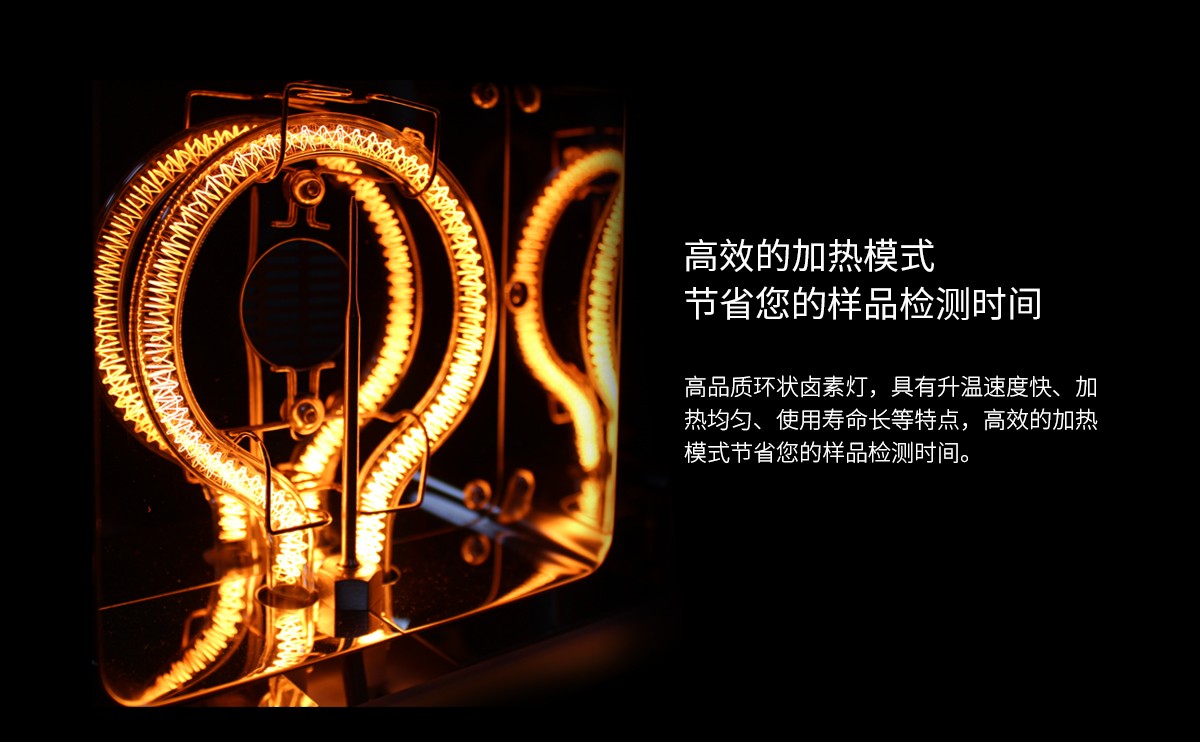
High-Efficiency Ring Halogen Lamp
The heating source and its regulation form the heating system. Loss-on-drying analyzers heat samples via absorbed infrared radiation (halogen, far-infrared, etc.). Common sources:
Ring halogen lamp.
Ring far-infrared dark-field heater.
Precise, fast temperature regulation — best from low-mass, fast-response halogen lamps — is the top factor; uniform heat distribution across the sample is equally vital for repeatable results. Both depend on the source, construction, and heating algorithms, which are instrument-specific — ask the manufacturer for a demonstration.
VM-5S Halogen Moisture Analyzer(0.005g/5mg)
The nominal weighing range; sometimes the maximum capacity (upper limit).
Large capacity matters little: typical samples need 3–5 g, special ones 20–30 g; over 70 g (pan + sample) virtually never occurs.
Depending on the sample type (e.g., solid, liquid, paste, solvent-containing), you need specific method parameters and accessories (Tables 2 and 3 below). For example, a gentle heating program and manual start mode are recommended for solvent-containing samples. It is therefore important to check which model offers the method flexibility (heating programs, switch-off modes, temperature range) your sample types require.
Table 2: Accessories for Sample Handling
| Accessory | Description | Purpose |
| Aluminum sample pan (standard) | High-quality, grease-free disposable sample pan | Suitable and recommended for all applications to ensure optimal repeatability. |
| Aluminum sample pan (heavy-duty) | Thicker than the standard aluminum pan | For measuring samples that shrink during drying and may warp a normal sample pan. |
| Glass fiber pad | High-quality disposable pad that contains no water and does not absorb water | Ensures optimal distribution and evaporation of liquid and paste samples, improving repeatability and reducing measurement time by up to 50%. |
| Hold-down grid | Steel ring | Used to hold down the sample or glass fiber pad during measurement. For samples that curl during measurement. |
| Large sample cage | Weighing pan with lid | For measuring moisture in large samples (including textiles). The sample can be compressed inside this cage. |
Table 3: Accessories for Routine Performance Testing and Management
| Accessory | Purpose |
| Automatic Temperature Calibrator | Verify the operating temperature of the heating unit and adjust it if necessary. |
| Calibration weight | Verify the weighing unit and adjust it if necessary. |
| Certified reference substance | Verify the accuracy of test results. |
| Printer | Record results with a thermal or dot-matrix printer. |
If you want to measure multiple substances, use one method per sample even when the method parameters are identical. Check the model's method storage capacity — it must hold an independent method for each substance.
Samples with low moisture content (<1%MC), such as plastics or white sugar, require superior measurement performance and 0.1 mg (0.001%MC) readability for reliable results. Special settings such as preheating and switch-off modes are also important, especially for plastics.
If your process tolerances are tight (e.g., moisture content between 5.6% and 6.0%), you need results with excellent repeatability. Beyond a good, reliable method, you need a high-performance rapid moisture analyzer with the best repeatability. VicoMeter models designed for this purpose feature high-performance weighing cells with readability up to 0.001%MC and a special construction that minimizes measurement errors.
When many operators use the instrument, and to prevent operator errors, it should be simple and guide users through the measurement. Features such as user guidance (graphics and text), method shortcuts, and weighing aids ensure every operator follows the correct procedure. You may also want to record who performed a measurement or prevent accidental setting changes — user management with configurable rights and password protection is a good choice. You may also want to check whether the instrument supports your preferred language for operation and documentation.
Keeping measuring equipment in good working order is essential, so regular cleaning of the instrument and its surfaces is critical. Make sure your rapid moisture analyzer is easy to clean: flat stainless-steel surfaces, no sharp edges, no dust-trapping areas. The VM-E and VM-EA series rapid moisture analyzers are good examples of hygienic design: with enclosed surfaces and no exposed weighing-cell openings, they are quick and easy to clean, reducing the risk of damage to the weighing unit.
Verifying the performance of your rapid moisture analyzer is essential for reliable moisture results. Routine testing of the weighing and heating units, plus periodic full instrument tests, should be carried out. See the testing and adjustment features of the rapid moisture analyzer:
Testing vs. adjustment: the two should be distinguished. Routine tests should be performed regularly, while adjustment is only required when the instrument is found out of tolerance.
Customizable test and adjustment points: weights and temperature can be tested and adjusted at the point of use.
Availability of a temperature kit: required for testing and adjusting the drying temperature, the most critical parameter to control.
Automated test procedures: no user intervention is needed during temperature calibration, saving time and eliminating errors.
Full instrument test: in addition to testing the heating and weighing units, the instrument as a whole should be tested. Many users want to verify performance with a temperature-sensitive test similar to an actual measurement.
When selecting a rapid moisture analyzer, look beyond the instrument itself and consider the supplier and its support network. Check the following aspects:
| Support Type | Benefits |
| Product demonstration and trial before purchase | Learn about the instrument's functions and choose the right model for your current and future needs. Inspect the instrument and experience its performance and ease of use by measuring your own samples. |
| Application Development | Get help measuring your specific samples and achieving good results, plus expert knowledge and assistance when problems arise. |
| On-Site Service | Instrument repair and preventive maintenance. Spare parts availability. Periodic (certified) calibration to documented performance. |
| Installation and Training | Installation and training for your new instrument by a technical engineer, ensuring accurate, smooth routine testing. |
| Your Requirement | Recommended Equipment | Reason |
| Moisture content <1% | VM-E01 | Best measurement performance with dedicated instrument settings: high resolution (0.1 mg / 0.001% MC), heating mode, switch-off mode |
| Best repeatability (tight tolerances) | VM-E01、VM-E10 | Optimum measurement performance to eliminate errors: high-performance weighing unit, separated weighing and heating units. |
| Two or more different samples | VM-E、VM-EA、VM-S | Method storage, method flexibility, reporting (result storage). |
| New substances and methods | VM-E、VM-EA | Method flexibility with customization support (method development). |
| Plastics | VM-E01 | Best measurement performance with dedicated instrument settings: high resolution (0.1 mg), heating mode, switch-off mode |
| Volatile substances | VM-E01、VM-E10、VM-01S | Gentle heating and manual switch-off mode |
| Paste or liquid samples | Glass fiber pad | Ensures optimal distribution and evaporation of liquid and paste samples, improving repeatability and cutting measurement time by up to 50%. A fast heating program is also recommended. |
| Bulky samples (fabrics, cotton, etc.) | Weighing pan with lid | The sample can be compressed under this mesh cover. |
| Curved samples | Hold-down grid | A steel ring used to hold down the sample or glass-fiber disc during moisture measurement. |
| Your Requirement | Recommended Equipment | Reason |
| Different users with varying levels of expertise | VM-E、VM-EA | User management with password protection, user guidance, multiple languages, method management. |
| Ensure procedures are followed and errors avoided | VM-E、VM-EA | User management with password protection, user guidance, multiple languages, method management. |
| Prevent settings from being changed | VM-E、VM-EA | User management with password protection. |
| Strictly regulated industries (GLP, GMP, USP, etc.) | VM-E、VM-EA | User management with password protection, temperature adjustment, weighing adjustment, data management, method management. |
Related Content
Related Products
Solutions
Recently Viewed Products




Copyright © Jiangsu Victor Instrument Meter Co., Ltd. All rights reserved | Sitemap | Technical Support: VicoMeter Operations Center